The Transition Metals - exam practice
The Transition Metals
Question 1 of 22
1 of 22
In which pair of species are the oxidation numbers of the d-block elements the same?
Question 2 of 22
2 of 22
The electronic configuration of the atoms of an element is 1s22s22p63s23p63d54s1.
What is the maximum oxidation number shown in compounds of this element?
Question 3 of 22
3 of 22
Which of the following species will not act as a ligand in the formation of a complex ion?
Question 4 of 22
4 of 22
Which has the greatest number of unpaired electrons in each of its atoms?
Question 5 of 22
5 of 22
Which of these complex ions could exist as stereoisomers?
Question 6 of 22
6 of 22
Chromium is classified as a transition element because
Question 7 of 22
7 of 22
Copper(II) sulfate solution is blue. This is because
Question 8 of 22
8 of 22
Platinum forms a complex with the formula Pt(NH3)2Cl2 and chromium forms a complex ion with the formula CrCl4-.
Considering the bonding between the central atom and the ligands in these complexes,
Question 9 of 22
9 of 22
The transition metal complex Pt(NH3)2Cl2 exists as two geometric isomers. This is because the complex
Question 10 of 22
10 of 22
The reaction below can be catalysed by either Fe2+ ions or Fe3+ ions.
S2O82-(aq) + 2I-(aq) ➔ 2SO42-(aq) + I2(aq)
This is because
Question 11 of 22
11 of 22
What is the number of stereoisomers that Ni(H2NCH2CH2NH2)2Cl2 can form?
Question 12 of 22
12 of 22
Which is not a correct statement?
Question 13 of 22
13 of 22
A solution absorbs light with wavelengths corresponding to red, yellow and green light.
Which ion is most likely to be in the solution?
Question 14 of 22
14 of 22
What does not affect the colour of the complex ion formed by a particular transition metal?
Question 15 of 22
15 of 22
Which factor does not affect the colour of a complex ion?
Question 16 of 22
16 of 22
[CoCl6]3- is orange while [Co(NH3)6]3+ is yellow. Which statement is correct?
Question 17 of 22
17 of 22
Which best explains why transition metal complexes are coloured?
Question 18 of 22
18 of 22
What is the overall charge, x, of the chromium(III) complex [Cr(H2O)4Cl2]x?
Question 19 of 22
19 of 22
What is the overall charge on the iron(III) complex ion [Fe(OH)2(H2O)4]Br
Question 20 of 22
20 of 22
Which electron configuration is that of a transition metal atom in the ground state?
Question 21 of 22
21 of 22
Iodide ions are oxidised by peroxodisulfate ions in aqueous solution:
2I- + S2O82- ➔ I2 + 2SO42-
This reaction is catalysed by Fe2+ ions. This catalysis is effective because
Question 22 of 22
22 of 22
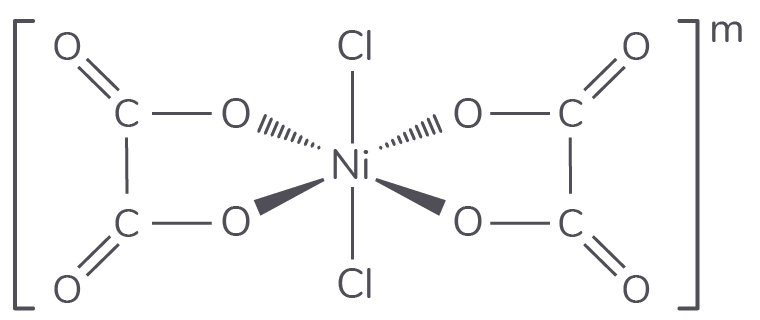
What is the coordination number of the nickel(II) ion and the overall charge, m, of this complex?