Kinetics - exam practice
Kinetics
Question 1 of 20
1 of 20
Two reactions are shown.
Reaction 1: N2(g) + 3H2(g) ⇌ 2NH3(g)
Reaction 2: 2O3(g) ⇌ 3O2(g)
In reaction 1, a finely powdered iron catalyst is used.
In reaction 2, a vaporised tetrachloromethane catalyst in ultraviolet light is used.
Which statement about the catalysts used is correct?
Question 2 of 20
2 of 20
Hydrogen ions catalyse the hydrolysis of esters.
Which statement is correct?
Question 3 of 20
3 of 20
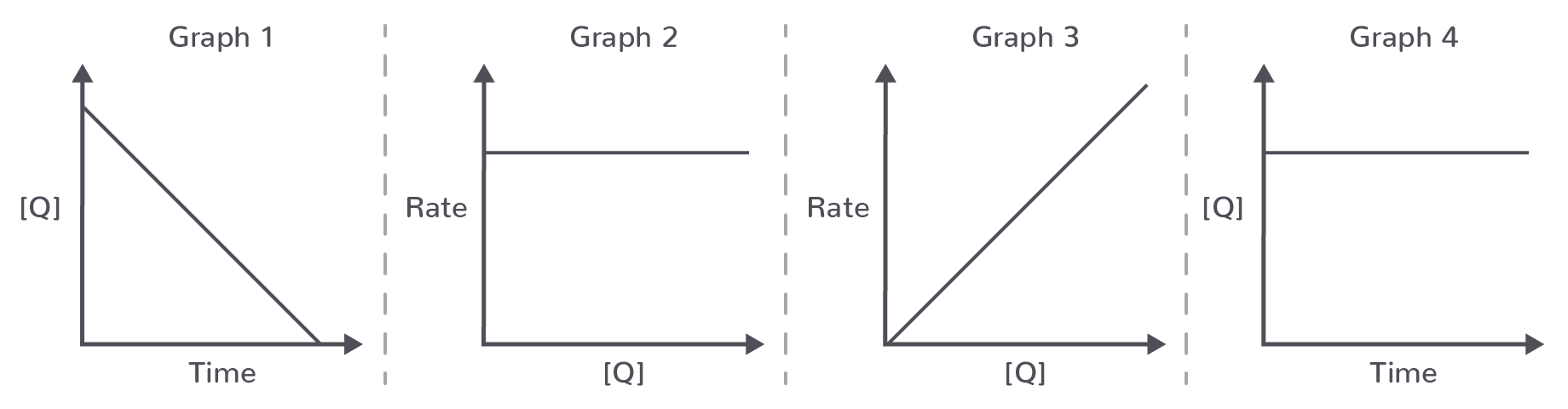
A reactant Q is converted into two products.
Which of these graphs shows that this reaction is first order with respect to Q?
Question 4 of 20
4 of 20
To determine the activation energy, Ea , for a reaction, a graph was plotted of ln k against 1/T, where k is the rate constant.
The Arrhenius equation is
The gradient of the graph is equal to
Question 5 of 20
5 of 20
Which statement about the rate determining step of a reaction is correct?
Question 6 of 20
6 of 20
Nitrogen dioxide reacts with carbon monoxide as in the equation below.
NO2 + CO ➔ NO + CO2
The mechanism is:
NO2 + NO2 ➔ NO + NO3 Slow
NO3 + CO ➔ NO2 + CO2 Fast
Which expression is the correct rate equation?
Question 7 of 20
7 of 20
A student plots ln k (y-axis) against 1/T (in K-1) for a reaction. The student gets a straight line graph that corresponds to the Arrhenius equation:
Which statement is correct?
Question 8 of 20
8 of 20
A graph is plotted of ln k against 1/T.
(k = rate constant, T = temperature in K)
The gradient has the numerical value of -55,000.
What is the activation energy, in kJ mol-1?
Question 9 of 20
9 of 20
The equation for the reaction of ICl and H2 is shown below.
2ICl(g) + H2(g) ➔ 2HCl(g) + I2(g)
The rate constant k for this reaction is 1.63 × 10⁻⁶ dm3 mol-1 s-1.
What is the overall order of the reaction?
Question 10 of 20
10 of 20
Solutions of two compounds, W and X, react together in the presence of a soluble catalyst, Y, as shown in the equation
2W + X ➔ Z
When the concentrations of W, X and Y are all doubled, the rate of reaction increases by a factor of four.
Which is a possible rate equation for this reaction?
Question 11 of 20
11 of 20
The rate equation for the hydrogenation of ethene:
C2H4(g) + H2(g) ➔ C2H6(g)
is rate = k[C2H4][H2].
At a fixed temperature, the reaction mixture is compressed to triple the original pressure.
What is the factor by which the rate of reaction changes?
Question 12 of 20
12 of 20
The rate expression for the reaction between X and Y is
rate = k [X]2[Y]
Which statement is correct?
Question 13 of 20
13 of 20
What are the units of the rate constant for a third order reaction?
Question 14 of 20
14 of 20
The results of an investigation of the reaction between P and Q are shown in this table.
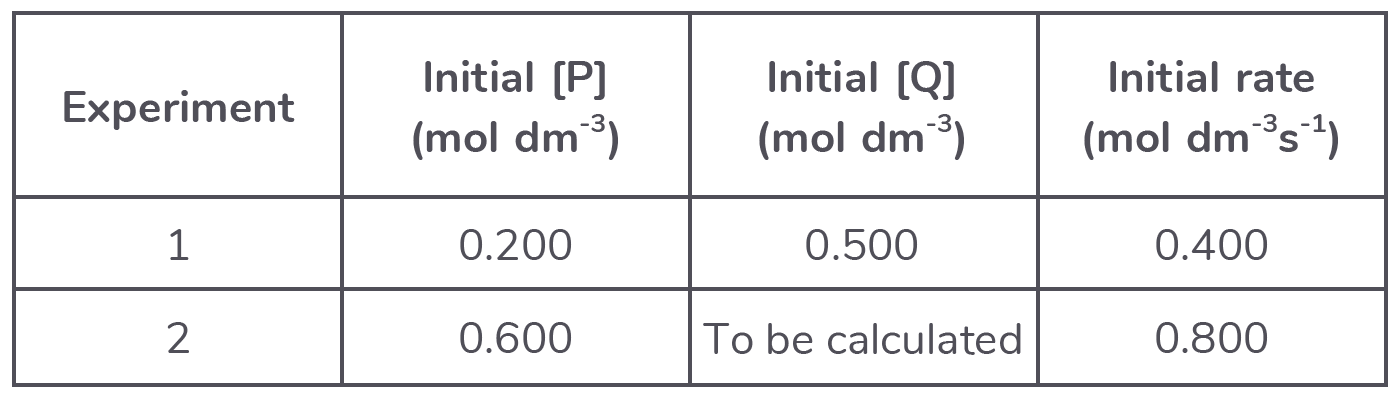
The rate equation is: rate = k[P][Q]2
What is the initial concentration of Q in experiment 2?
Question 15 of 20
15 of 20
What is the effect of increasing temperature on the rate contant, K?
Question 16 of 20
16 of 20
Which is true of an Arrhenius plot of lnk (y-axis) against ?
Question 17 of 20
17 of 20
The rate expression for the reaction X(g) + 2Y(g) ➔ 3Z(g) is
rate = k[X]0[Y]2
By which factor will the rate of reaction increase when the concentrations of X and Y are both increased by a factor of 3?
Question 18 of 20
18 of 20
Which is correct about reaction mechanisms?
Question 19 of 20
19 of 20
The reaction between NO2 and F2 gives the following rate data at a certain temperature.
| [NO_2_] (mol dm^-3^) | [F_2_] (mol dm^-3^) | Rate (mol dm^-3^ min^-1^) |
|---|---|---|
| 0.15 | 0.20 | 0.10 |
| 0.30 | 0.20 | 0.40 |
| 0.15 | 0.40 | 0.20 |
What is the overall order of reaction ?
Question 20 of 20
20 of 20
2NO(g) + O2(g) ➔ 2NO2(g)
The rate equation for the reaction above is rate = k[NO]2[O2]
Which statement is not correct?