7.7 - Gas Exchange in Fish
- 1
The challenges bony fish face in extracting oxygen from water
- 2
The structure and function of fish gills for gas exchange
- 3
The countercurrent exchange system in fish gills
- 4
How changes in the volume of the buccal cavity ventilate the gills
Respiratory systems in bony fish
Large, active, bony fish have high oxygen needs. These needs exceed simple diffusion across the body surface, which is also covered with scaly skin preventing gas exchange.
Bony fish have evolved specialised respiratory systems to meet the challenges of extracting oxygen from water.
Some of these challenges include:
- Water is denser and more viscous than air, resulting in slower diffusion of oxygen.
- Water has less oxygen than air.
- Bony fish are very active so have high oxygen demands.
Structure of the gas exchange system in bony fish
Gills allow bony fish to efficiently take up oxygen from water and to remove carbon dioxide.
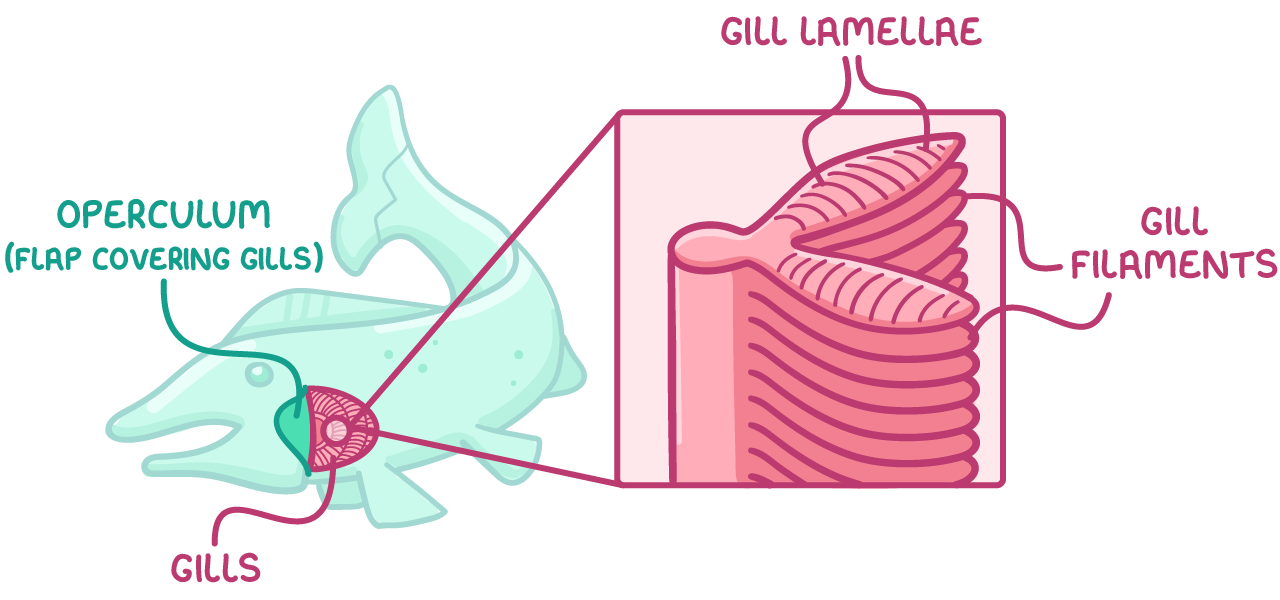
Structure of the gills:
- Gills are covered by an operculum flap.
- Gills consist of stacked filaments containing gill lamellae.
- Gill lamellae are surrounded by extensive blood vessels.
Adaptations of the gills for efficient gas exchange:
- The lamellae provide a large surface area.
- The lamellae membranes are thin to minimise diffusion distance.
- The gills have a rich blood supply to maintain steep diffusion gradients.
- The countercurrent flow of blood and water creates even steeper concentration gradients.
- Overlapping filament tips increase resistance, slowing water flow over gills and allowing more time for gas exchange.
Countercurrent exchange principle
The gills of bony fish allow countercurrent flow of blood and water, which is much more efficient than a parallel flow.
Countercurrent flow
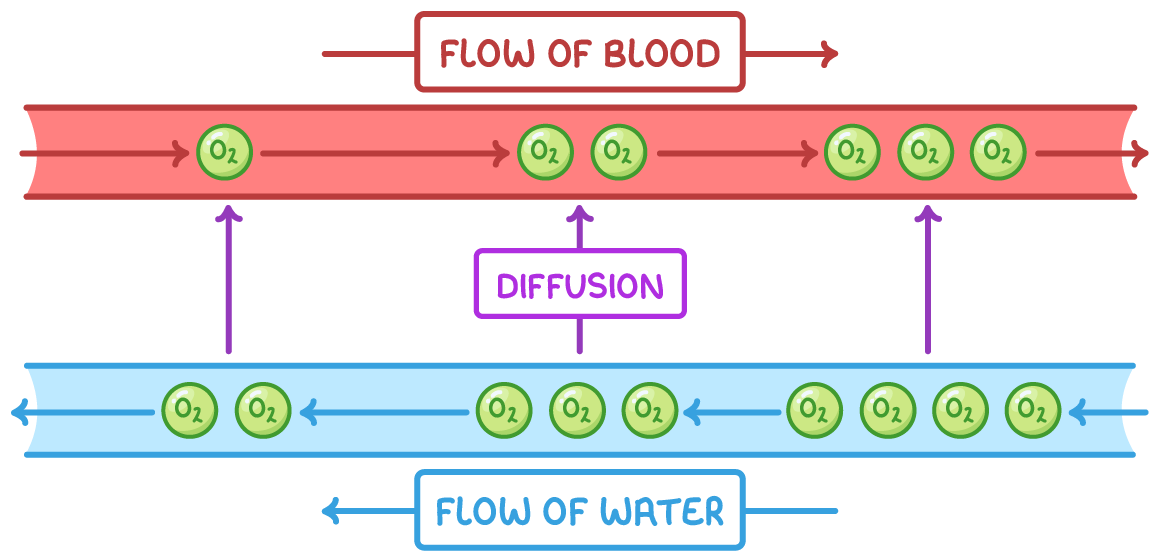
In a countercurrent flow system:
- Blood and water flow over the lamellae in opposite directions.
- This means that oxygen-rich blood meets water that is at its most oxygen rich when it first moves across the gills, maximising diffusion of oxygen into the blood.
- Oxygen-poor blood returning from body tissues meets oxygen-reduced water that has had most of its oxygen removed, still allowing diffusion of oxygen into the blood.
- This maintains a steep concentration gradient across the entire gill.
Parallel flow
The diagram below shows how diffusion would occur in a parallel flow system.
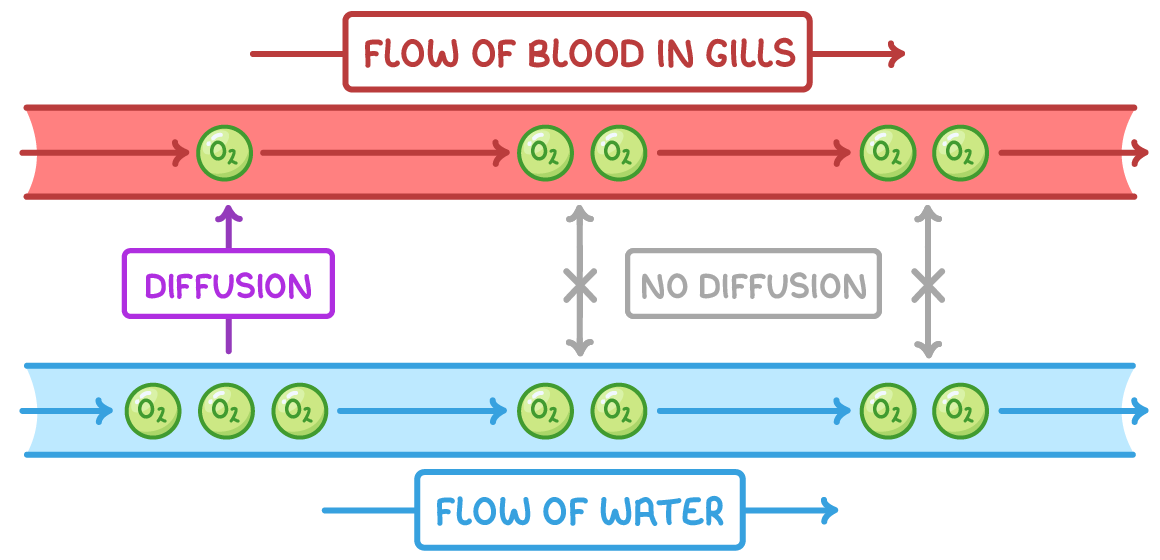
Countercurrent exchange systems enable more efficient gas transfer than parallel flow, because parallel flow reduces the concentration gradient so less oxygen can be absorbed.
Ventilation via the buccal cavity
The buccal cavity is the mouth and throat area of bony fish.
Bony fish ventilate their gills by opening and closing their mouths, changing the volume of the buccal cavity:
- When a fish opens its mouth, this increases the volume of the buccal cavity.
- This decreases the pressure, which pulls water into the buccal cavity.
- Water flows over the gills.
- Water flows out through the operculum.
This drives unidirectional water flow for ventilation, providing freshly oxygenated water and removing carbon dioxide.