7.5 - Measuring Ventilation
- 1
Measuring lung capacity
- 2
How to measure lung volume
- 3
How to calculate ventilation rate
Measuring data on lung function, volume, and capacity
There are various instruments that can measure the flow of air into and out of the lungs, providing data on lung function and capacity.
Some examples of instruments that provide data on lung function include:
- Peak flow meter - This measures the maximum speed of expiration through a mouthpiece by tracking the movement of an indicator.
- Vitalograph - This records a graph showing the volume and rate of forced expiration through a mouthpiece.
- Spirometer - This calculates different lung volumes using a chamber containing a known volume of gas connected to a mouthpiece and recorder.
Measuring lung volume
We can use spirometer traces to work out the volume of air in the lungs and create graphs like the one below.
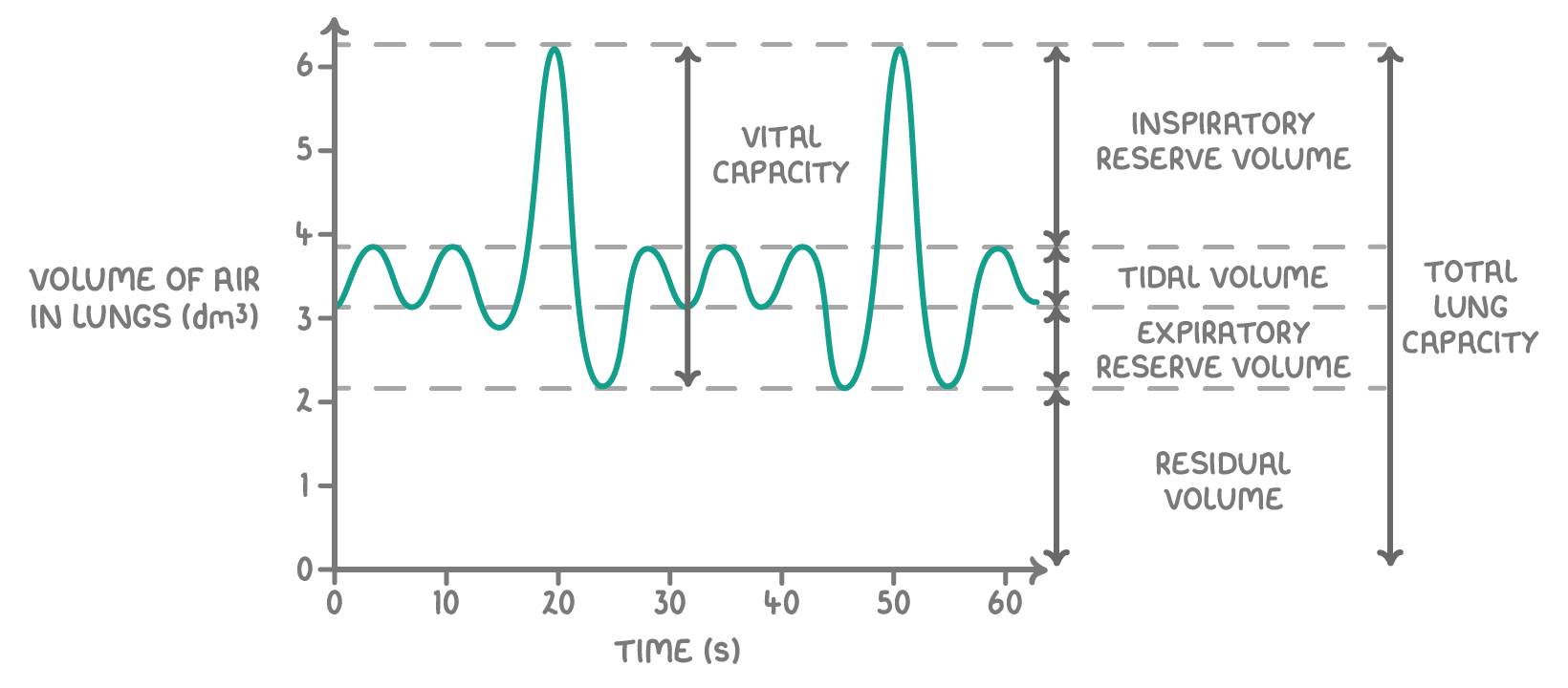
Using this graph, you can calculate:
- Breathing rate - This is the number of breaths taken per minute, measured by counting the number of peaks in a minute.
- Tidal volume - This is the volume of air breathed in or out in an average breath during rest, measured from the height of each peak at rest.
- Vital capacity - This is the maximum volume of air that can be inhaled or exhaled in one deep breath, measured from the maximum peak height.
- Inspiratory reserve volume - This is the maximum volume of air that can be inhaled above a normal inhalation.
- Expiratory reserve volume - This is the maximum volume of air that can be exhaled above a normal exhalation.
- Residual volume - This is the volume of air that remains in the lungs after the largest possible exhalation.
- Total lung capacity - This is the vital capacity added to the residual volume.
Calculating oxygen consumption
Oxygen consumption is the volume of oxygen used per minute.
If we had a spirometer trace, we could also measure oxygen consumption. This is the slope of a spirometer trace.
We can calculate oxygen consumption as the change in the volume of gas in the spirometer over a period of time and divide this value by the time taken.
Ventilation rate
Ventilation rate is the volume of oxygen inhaled per minute.
Ventilation rate can be calculated as follows:
- Measure tidal volume (dm3).
- Measure breathing rate (min-1).
Worked example - Calculating ventilation rate
An individual took 15 breaths in a minute. Their tidal volume was measured as 500 cm3.
Calculate their ventilation rate in dm3 min-1.
Step 1: Equation
Step 2: Conversion
to convert cm3 into dm3, divide by 1,000
Step 3: Substitution and correct evaluation