2.5 - Carbohydrates: Monosaccharides & Disaccharides
- 1
The different types of monosaccharides
- 2
The difference between alpha and beta glucose
- 3
The different types of disaccharides
- 4
The reactions which form and break down disaccharides
Monosaccharides
Monosaccharides are the simplest form of carbohydrates, also known as 'simple sugars'. Monosaccharides are soluble, sweet-tasting and are found in many foods such as fruits, vegetables, and grains.
They have the general formula (CH2O)n where 'n' can be any number from 3 to 7.
Monosaccharides are classified according to the number of carbon atoms in each molecule:
Pentose sugars (5 carbon atoms)
- Ribose
- Deoxyribose
Hexose sugars (6 carbon atoms)
- Glucose
- Fructose
- Galactose
Alpha-glucose and beta-glucose
Glucose is a hexose (6-carbon) sugar with the formula C6H12O6. The atoms in glucose can be arranged in two different ways.
This means that there are two isomers of glucose:
- Alpha-glucose (α-glucose)
- Beta-glucose (β-glucose)
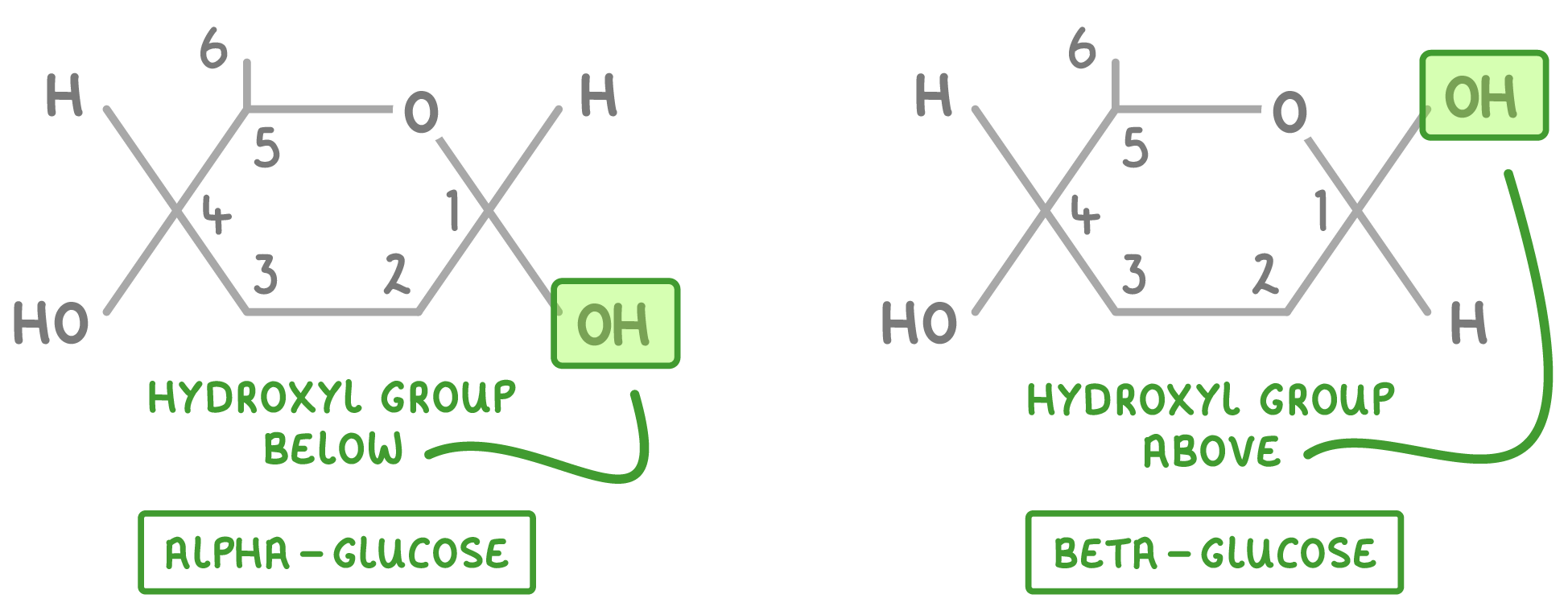
The only difference between the two forms is the orientation of the hydroxyl group (OH) on carbon 1 (the first carbon atom in the ring).
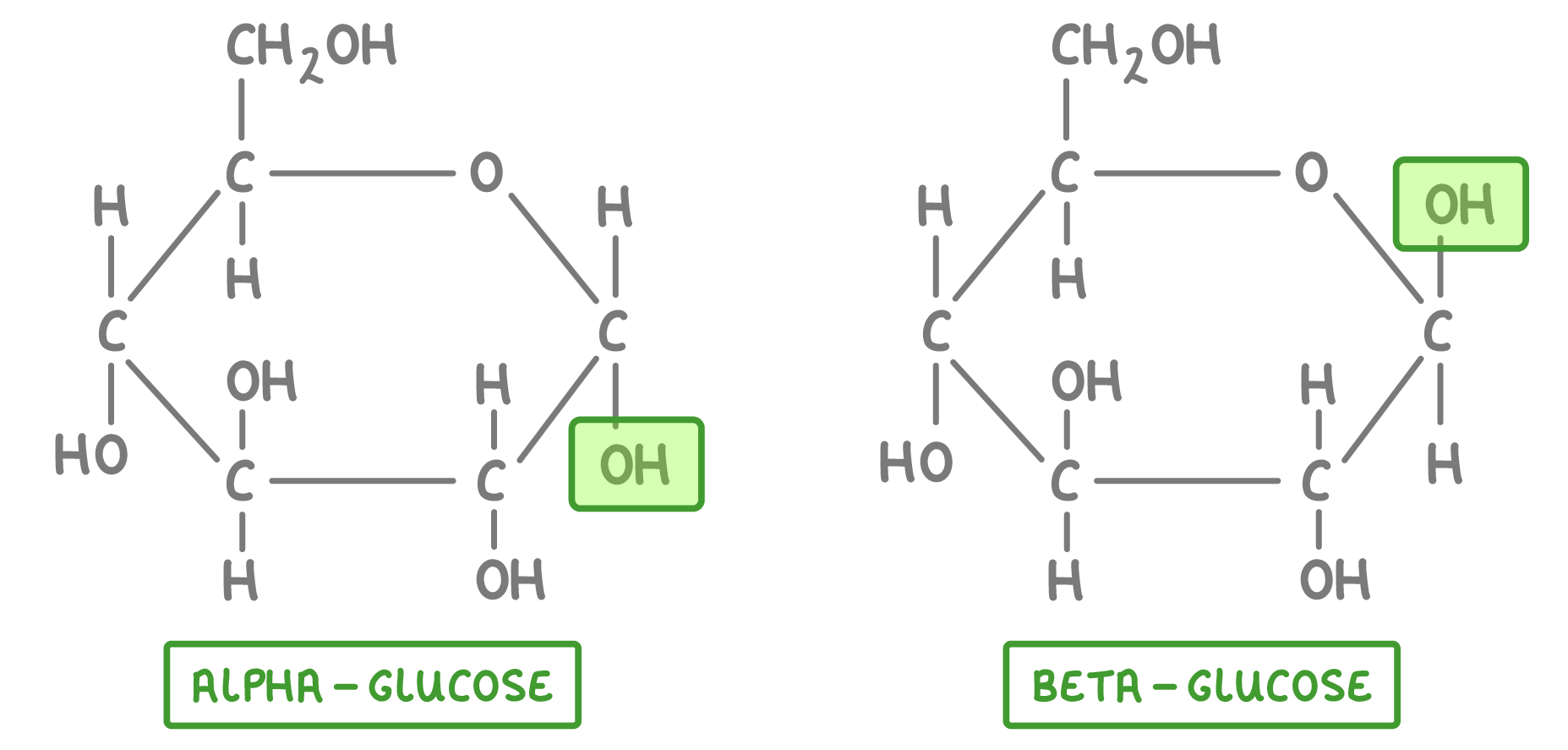
This diagram is showing the same molecules, but shows all the atoms.
Properties and uses of glucose
Glucose is used as the primary energy source in animals and plants.
The following features of glucose help it to function as an energy source:
- It is soluble - The hydroxyl groups can form hydrogen bonds with water, so it can be transported around organisms.
- Its bonds store lots of energy - This energy is released when the bonds are broken.
Disaccharides
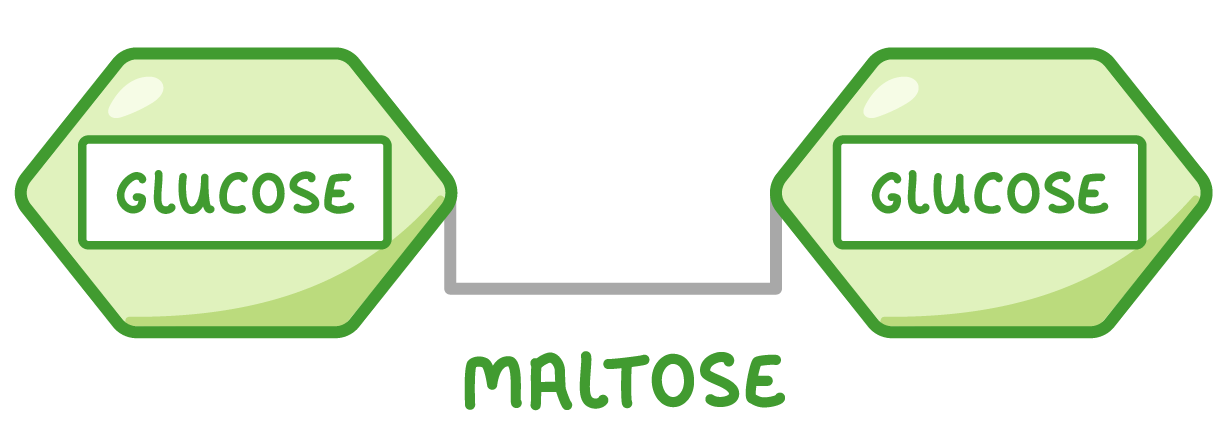
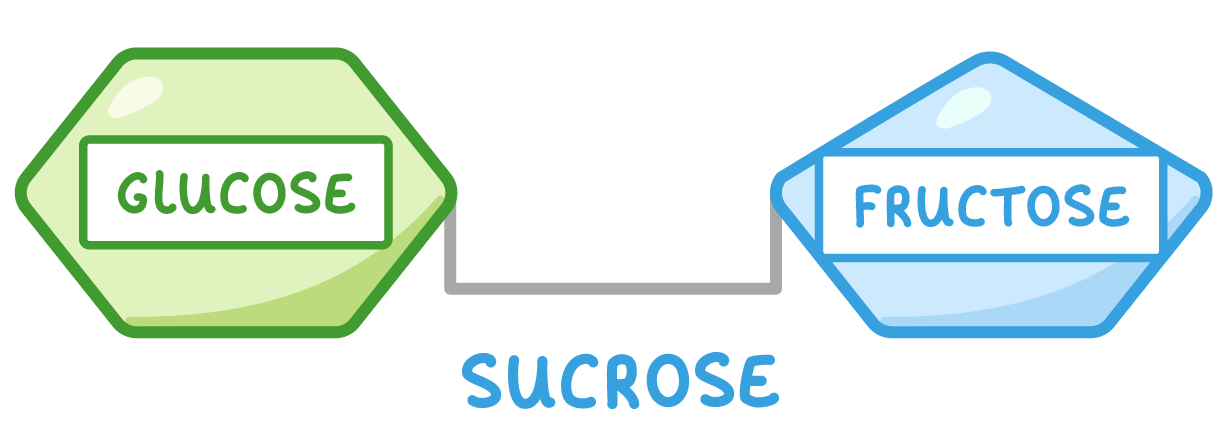
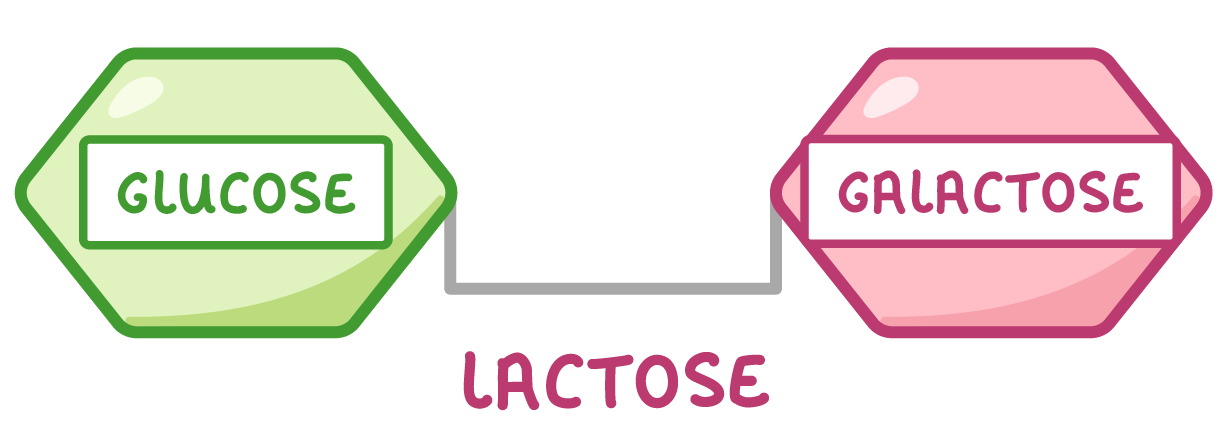
Disaccharides are formed when two monosaccharides join together. Examples of disaccharides include maltose (found in grains and cereals), sucrose (used as a transport sugar in plants), and lactose (the main carbohydrate found in milk).
- Maltose is made up of glucose joined to glucose.
- Sucrose is made up of glucose joined to fructose.
- Lactose is made up of glucose joined to galactose.
Disaccharide formation and breakdown
Disaccharides are created via condensation reactions, and broken down via hydrolysis reactions. These reactions involve the formation or the breakdown of a covalent bond known as a glycosidic bond.
Condensation reaction
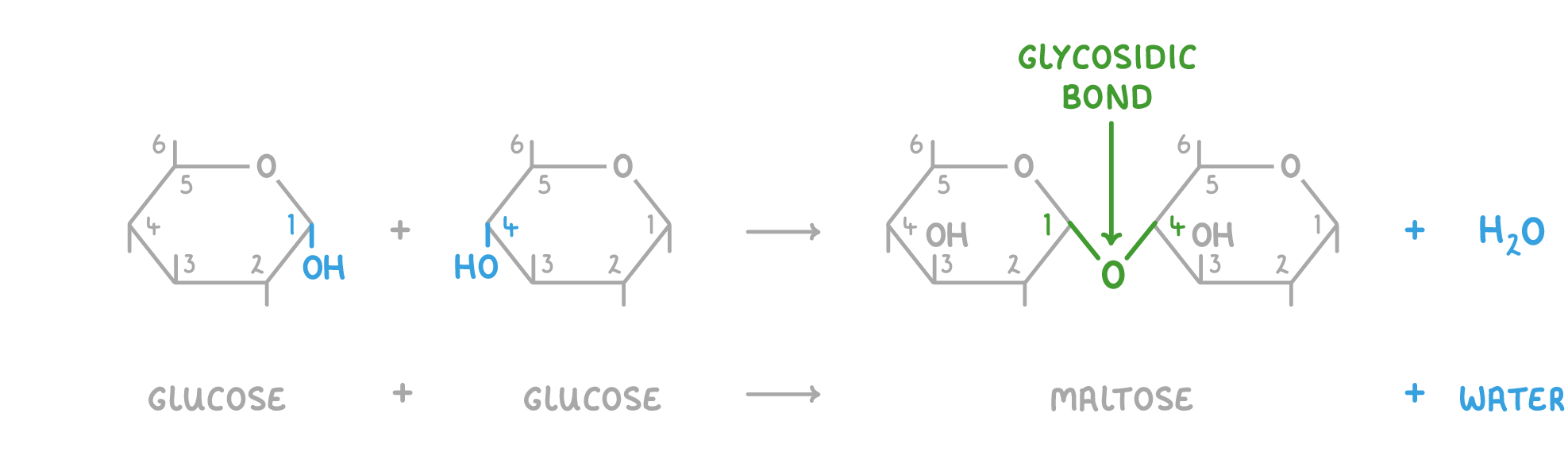
When two monosaccharides join, a hydroxyl group (OH) of one monosaccharide reacts with a hydroxyl group (OH) of another monosaccharide. This forms a glycosidic bond, and a water molecule (H2O) is released.
In the image above, the hydroxyl groups on carbons 1 and 4 are reacting together, so a 1-4 glycosidic bond forms, but they can also form between other carbons.
Hydrolysis reaction
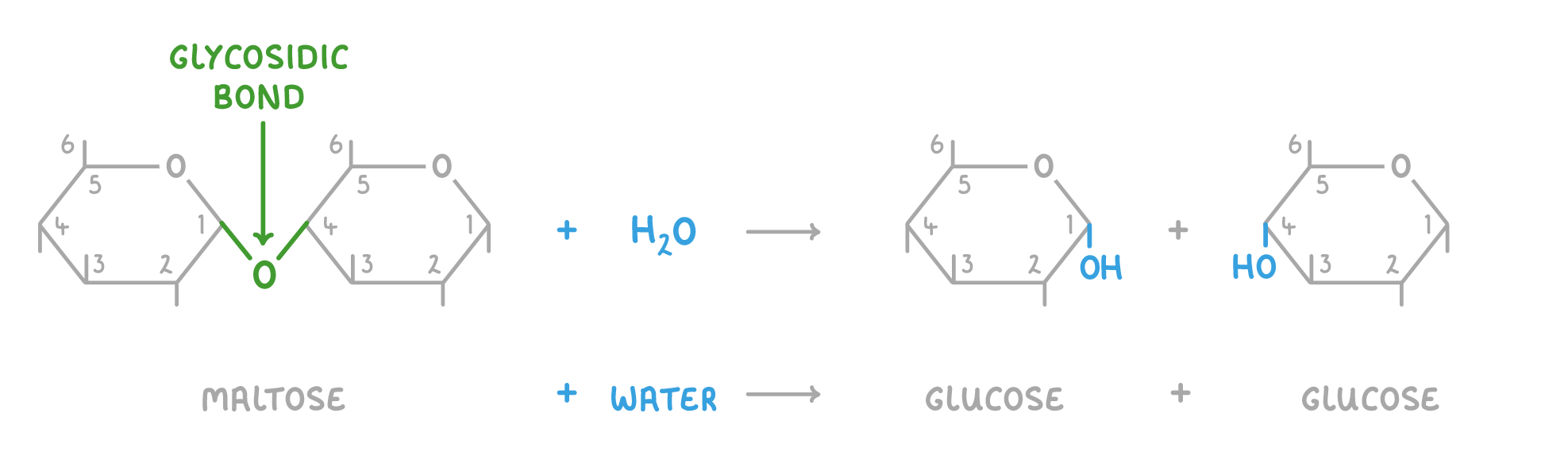
When a water molecule (H2O) is added to a disaccharide, the glycosidic bond is broken to release the 2 monosaccharides.