11.3 - Non-random Sampling
- 1
Differences between random and non-random sampling
- 2
Types of non-random sampling
- 3
Non-random sampling techniques
- 4
Measuring abiotic factors
Random and non-random sampling
Non-random sampling involves selection based on specific criteria or patterns and the sample is not chosen at random.
Differences between random and non-random sampling:
- Random sampling removes human bias in sample selection, improving reliability.
- Non-random sampling does not use random selection so is prone to bias.
Types of non-random sampling
There are three main types of non-random sampling.
- Opportunistic:
- This uses conveniently available organisms.
- It may not be representative of the population.
- Stratified:
- This divides the population into subgroups (strata) based on a characteristic.
- A random sample is taken from each subgroup/stratum.
- The number of samples taken in each stratum is proportional to the size of the stratum.
- Systematic:
- This samples different areas in a habitat separately at regular intervals to avoid bias.
Line transects and belt transects
Transect sampling is a method of studying the distribution of organisms in a specific area. It is typically used in systematic sampling.
Transect sampling:
- Mark a line (transect).
- Take samples along this line at regular intervals.
This lets us study how species' distributions change across different areas within a habitat, like from a woodland to a lake.
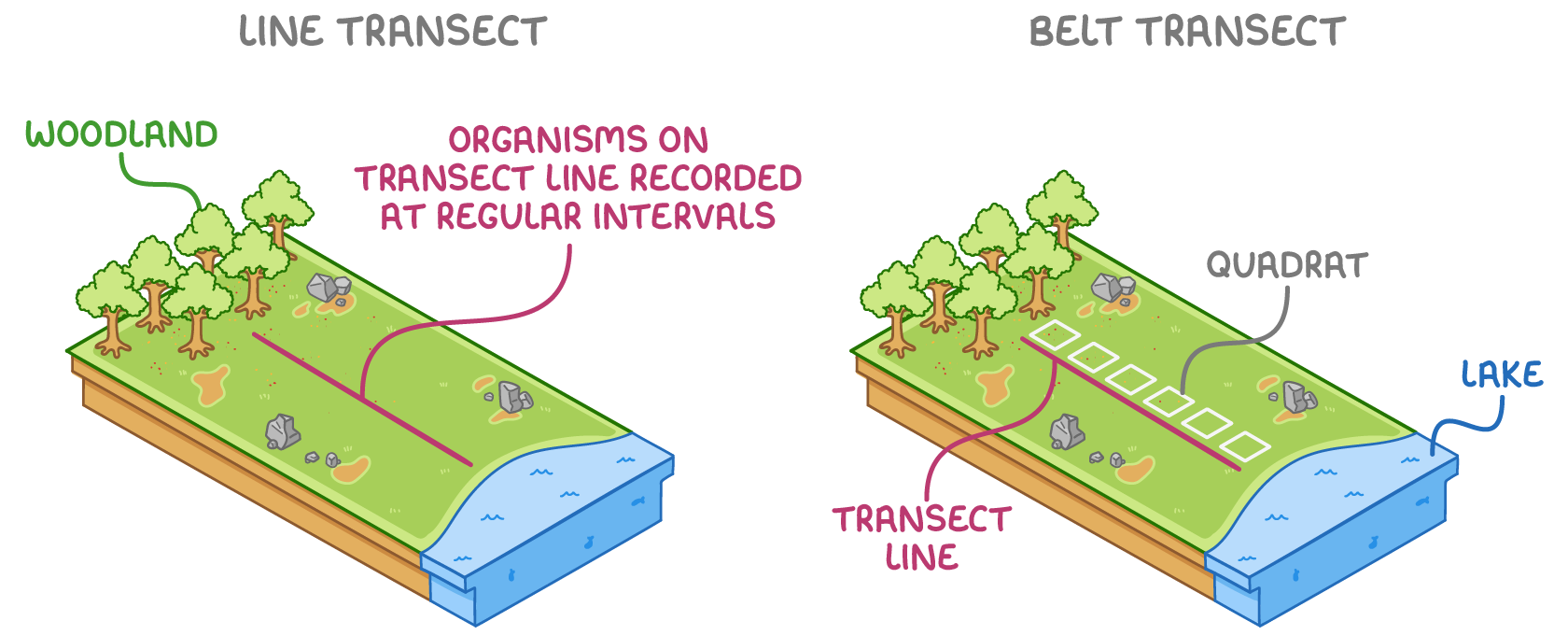
There are two main types of transect sampling:
- Line transect - Samples are taken at regular intervals along a line between two points.
- Belt transect - Samples are taken in an area along a line or between two parallel lines, by using quadrats placed either side by side (continuous) or at regular intervals (interrupted).
Measuring abiotic factors
Abiotic factors directly affect the distribution of organisms in a habitat, so they are useful to measure when sampling.
We can measure abiotic factors like:
- Light, humidity, and temperature (using sensors).
- pH and wind speed (using probes).
- Dissolved oxygen (using specialised probes).
Advantages of measuring abiotic factors:
- They can detect rapid changes.
- They can reduce human error in taking readings.
- They can achieve a high degree of precision
- They allow data to be stored and tracked on a computer.
Investigating the effect of abiotic factors on distribution
For example, there may be seashore vegetation gradients based on shell deposit acidity, where the pH is lower closer to the sea due to rotting organic matter.
This could be investigated by:
- Placing the transect line perpendicular to the shore.
- Taking quadrat samples at regular intervals.
- Recording the percentage cover of the target species.
- Measuring the environmental variable (e.g. pH) at regular intervals.
- Producing a graph of the data and analysing the relationship.