10.2 - Five Kingdoms & Three Domains
- 1
The five kingdom classification system
- 2
The three domain classification system
The five kingdom system
We generally classify organisms into five different kingdoms.
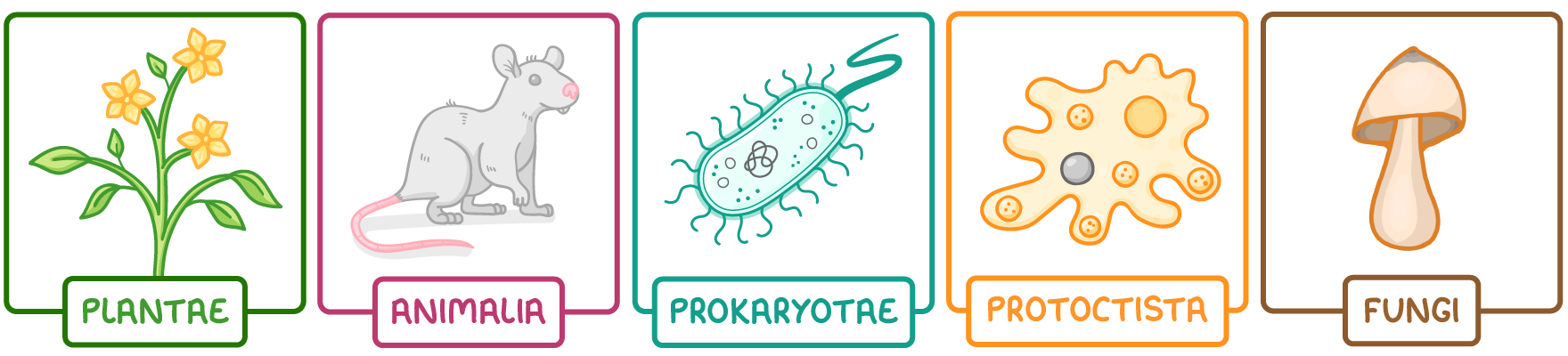
| Plantae | Animalia | Prokaryotae | Protocista | Fungi | |
|---|---|---|---|---|---|
| Cell type | Eukaryotic | Eukaryotic | Prokaryotic | Eukaryotic | Eukaryotic |
| Cellular organisation | Multicellular | Multicellular | Unicellular | Unicellular or simple multicellular | Unicellular or multicellular, with a body made of hyphae |
| Nucleus and other membrane-bound organelles | Present, including chloroplasts | Present, no chloroplasts | Absent | Present, sometimes including chloroplasts | Present, no chloroplasts |
| Cell walls | Yes, made of cellulose | None | Yes, often made of peptidoglycan | Variable | Yes, made of chitin |
| Nutrition | Autotrophic (photosynthetic) | Heterotrophic | Autotrophic, heterotrophic, or parasitic | Autotrophic, heterotrophic, or parasitic | Saprophytic, absorb dissolved organic nutrients from dead matter |
| Storage of sugars | Starch | Glycogen | Glycogen | Variable | Glycogen |
| Reproduction | Use seeds or spores | Variable | Binary fission | Variable | Spores |
The three domain system
Older classification systems become outdated when new molecular and genetic data arise. This means that taxonomy is periodically updated and reorganised to reflect progressing scientific knowledge, as reflected by the new three domain system.
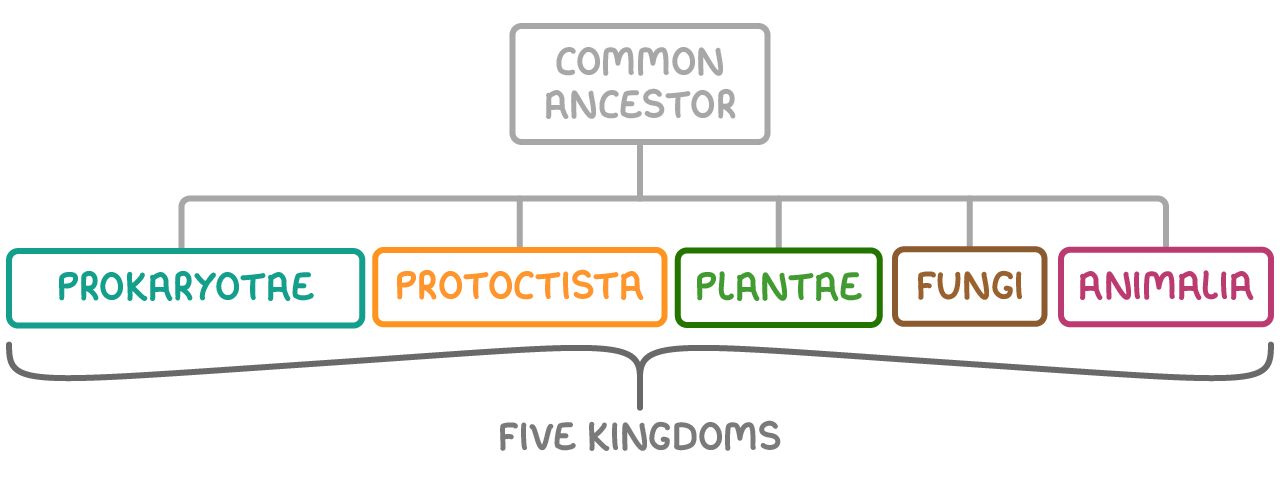

The three domain system proposes six kingdoms instead of five, because there is evidence for splitting the kingdom Prokaryotae into two separate kingdoms: Eubacteria and Archaebacteria. It recognises differences between Bacteria, Archaea, and Eukarya (all eukaryotic organisms).
Domain Bacteria
- Contains the kingdom Eubacteria only, found in all environments.
- Prokaryotic unicellular organisms.
- Distinct cell membrane lipids.
- Have peptidogylcan (murein) in their cell walls.
- Unique RNA polymerase enzyme.
Domain Archaea
- Contains the kingdom Archaebacteria only, typically found in extreme environments.
- Prokaryotic unicellular organisms.
- Have histones so gene and protein synthesis is more similar to Eukarya than Bacteria.
- No peptidogylcan in their cell walls.
- Different cell membranes that contain fatty acids bound to glycerol by ether linkages.
- Have a more complex form of RNA polymerase than Bacteria.
Domain Eukarya
- Contains four kingdoms from the five kingdom system: Animalia, Plantae, Fungi, Protoctista.
- All have nuclei and membrane-bound organelles.
10.3 - Phylogeny Next up
How were these notes?