9.2 - Water Transport in Plants
- 1
How water moves through a plant
- 2
The apoplast pathway and the symplast pathway
- 3
The cohesion-tension theory
- 4
How transpiration relates to gas exchange
- 5
How to use a potometer to estimate transpiration rate
How water moves through a plant
Water enters plants through their roots.
Water then moves through a plant as follows:
- Water enters a plant's root hair cells via osmosis.
- It moves through the cell cytoplasm or cell walls towards the xylem.
- The xylem transports water from the roots up to the leaves.
- Water is used for photosynthesis.
- Some water evaporates from leaf cells by transpiration and diffuses out of the plant.
The apoplast pathway and the symplast pathway
There are two main pathways taken by water once it has entered a plant root to reach the xylem: the apoplast pathway and the symplast pathway.
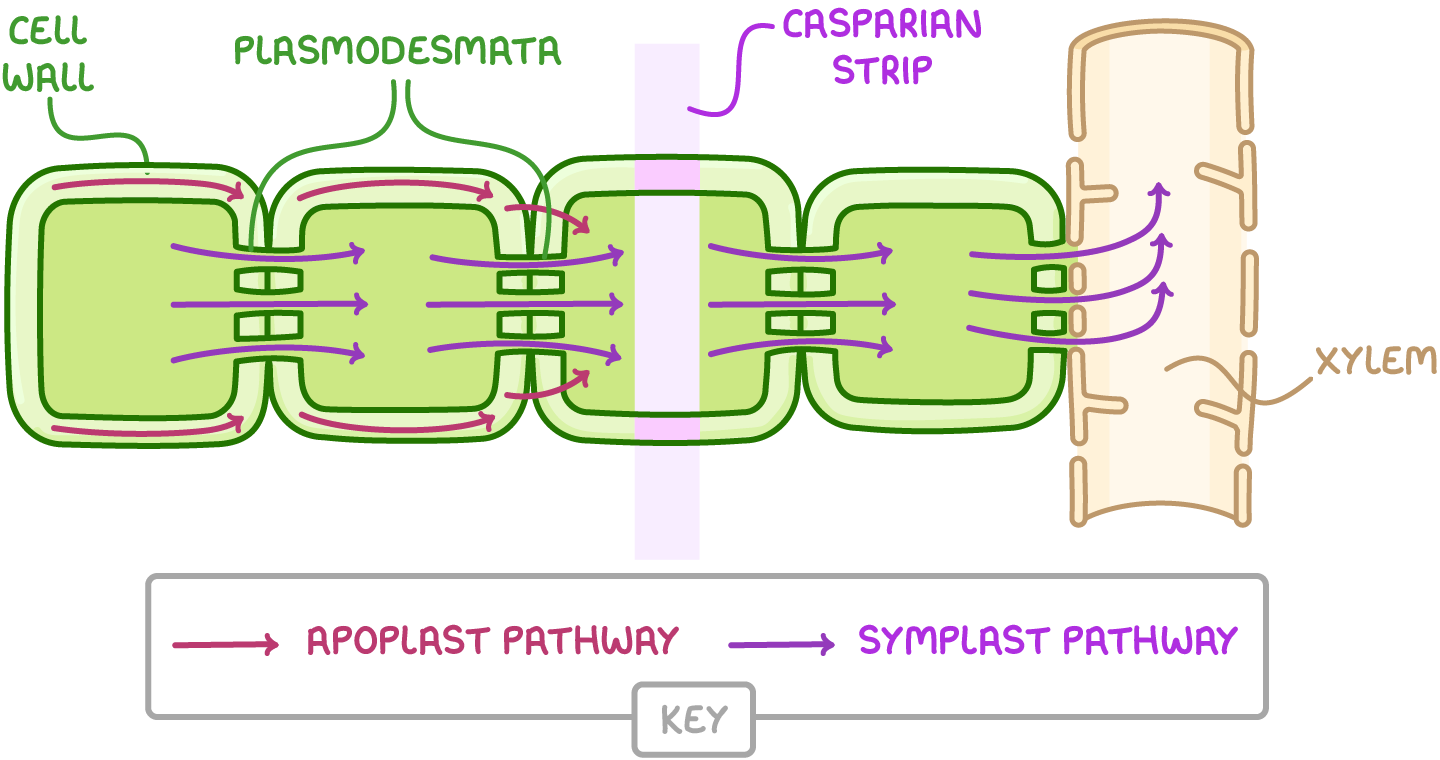
The apoplast pathway:
- Water moves through spaces in the cell walls and between cells.
- This occurs due to the cohesive and adhesive properties of water.
The symplast pathway:
- Water moves from cell to cell through the cytoplasm and plasmodesmata.
- This occurs due to water potential gradients.
The Casparian strip
The apoplast pathway is blocked at the root endodermis by the Casparian strip.
This is a band of a waterproof substance called suberin that surrounds the endodermis cells. It forces water out of the apoplast pathway and into the symplast pathway.
The pathway to leaf cells
After the xylem transports water up through a plant, water exits the xylem into leaf cells. It travels from the xylem to photosynthesising leaf cells mainly via the apoplast pathway.
Water then evaporates from cell walls in the leaf into air spaces so it can exit the plant through its stomata.
The cohesion-tension theory
The cohesion-tension theory explains how water moves upwards through the xylem against gravity.
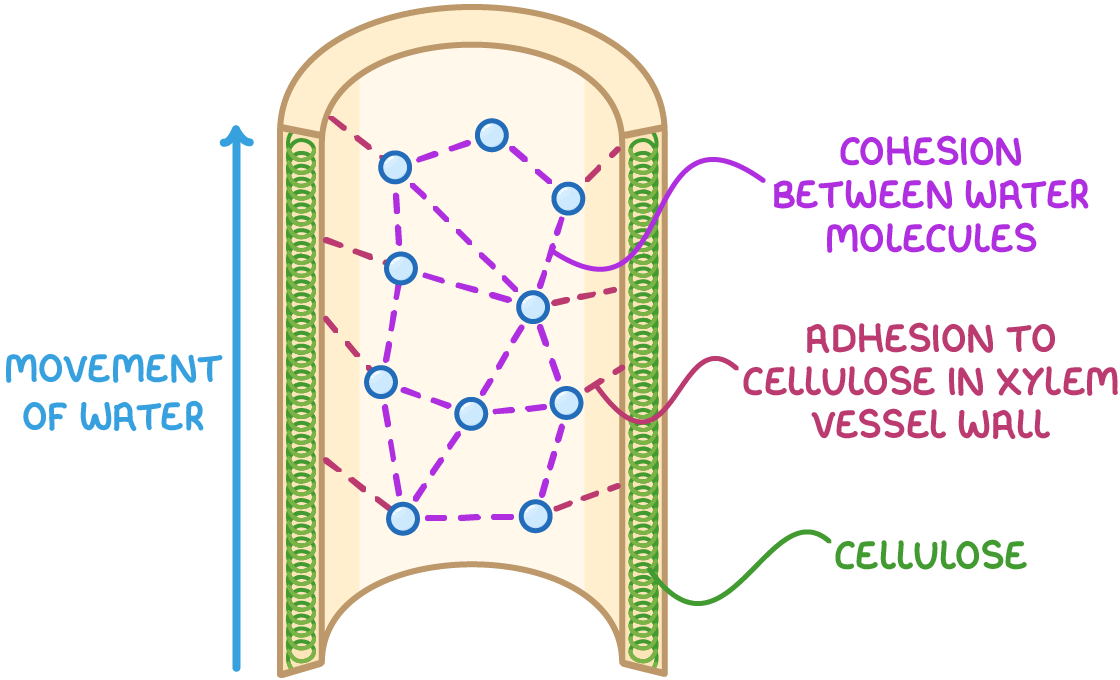
This occurs due to various factors:
- Cohesion - Hydrogen bonding causes water molecules to stick together and move as one continuous column.
- Adhesion - Hydrogen bonding between polar water molecules and non-polar cellulose in xylem vessel walls pulls water upwards through the xylem.
- Transpiration pull - Evaporation of water at leaves creates the transpiration pull, and this tension is transmitted down the whole water column due to cohesion.
This causes water to be pulled up through the xylem vessels.
How transpiration relates to gas exchange
Transpiration is the evaporation of water from aerial parts of plants, especially leaves.
Why transpiration occurs:
- Water evaporates (changes from liquid water into gaseous water vapour) from the moist surfaces of mesophyll cells.
- Stomata open so they can absorb carbon dioxide for photosynthesis.
- This provides a pathway for water vapour loss through the open stomata.
- Water vapour moves down a water potential gradient from the air spaces in the leaf into the atmosphere.
So, transpiration is a side effect of gas exchange.
Factors affecting the transpiration rate
Four main factors affect the transpiration rate: light intensity, temperature, humidity, and wind speed.
These factors affect the transpiration rate as follows:
- Light intensity - At high light intensities, stomata open for maximum CO2 absorption for photosynthesis, increasing the transpiration rate.
- Temperature - At high temperatures, evaporation of water molecules is faster due to higher kinetic energy, increasing the transpiration rate.
- Humidity - Low humidity increases the water vapour gradient between the leaf and atmosphere, increasing the transpiration rate.
- Wind speed - High wind speeds increase the water vapour gradient between the leaf and atmosphere, increasing the transpiration rate.
Using a potometer
A potometer is used to measure the rate of transpiration.
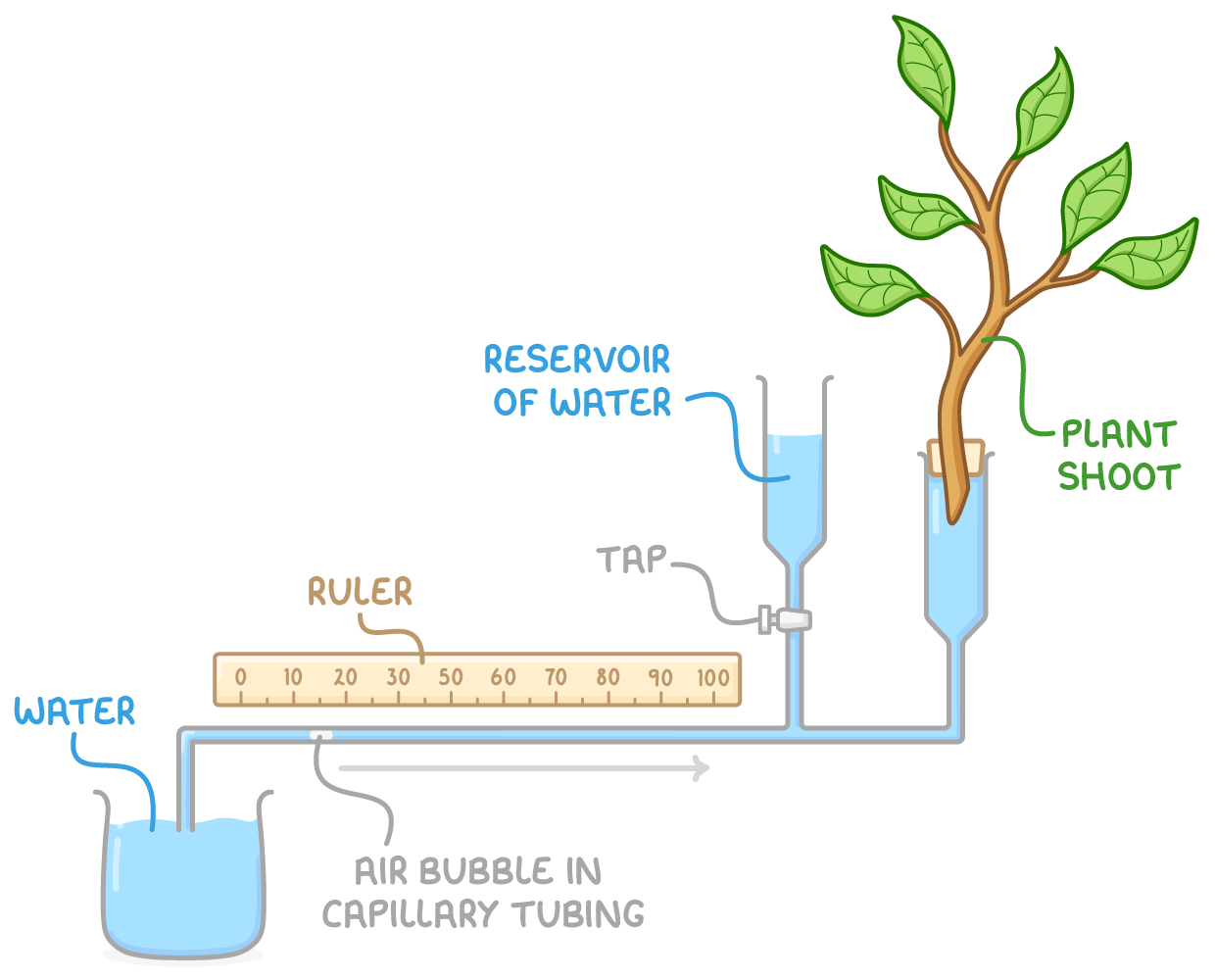
Steps in using a potometer:
- Cut the shoot underwater at slant to increase the surface area for water uptake.
- Assemble the potometer with the shoot submerged in water.
- Keep the capillary tube end of the potometer submerged throughout the experiment.
- Check that the apparatus is airtight.
- Dry the leaves, and give the shoot time to acclimatise.
- Shut the tap, form an air bubble and record its position.
- Measure the distance the air bubble moves and the time taken.
- Change one variable at a time and keep everything else constant.
Calculating the rate of transpiration
To calculate the rate of transpiration, we first need to calculate the volume of water that has been taken up by the plant to estimate how much has been lost from the plant over this time period. Then we need to turn this value into a rate.
We can do this as follows:
-
Calculate the cross-sectional area of the capillary tube (this is the area of the circle that forms a cross section of the tube):
-
Calculate the volume of water uptake by multiplying the value from step 1 by the distance the air bubble travelled, 'd' (that is, calculate the area of the cylinder of water that has been taken up by the plant):
-
Calculate the rate of water uptake (an estimate for the rate of transpiration) by dividing the value calculated in step 2 by the time taken: