Communicable Diseases - exam practice
Communicable Diseases
Question 1 of 11
1 of 11
The diagram represents the general structure of an antibody.

Which of the numbered part(s) of the diagram represent the part of the antibody that has the same sequence of amino acids in all antibodies?
Question 2 of 11
2 of 11
Which statements correctly describe lymphocytes?
1 - each B lymphocyte has the ability to make several types of antibody molecules
2 - some B lymphocytes and T lymphocytes become memory cells
3 - plasma cells secrete antibodies into the blood plasma
4 - some T lymphocytes stimulate macrophages to kill infected cells
Question 3 of 11
3 of 11
Bacteria that infect skin wounds can become resistant to the antibiotic commonly used to kill them.
What explains how these bacteria could become resistant to the antibiotic?
Question 4 of 11
4 of 11
Which are specific immune responses?
1 - phagocytosis
2 - production of antibodies
3 - effect of histamine
Question 5 of 11
5 of 11
What are the function(s) of T lymphocytes during an immune response?
1 - destroy infected body cells
2 - differentiate into memory cells
3 - secrete antibodies
Question 6 of 11
6 of 11
What happens when people are injected with dead bacteria?
Question 7 of 11
7 of 11
Antibodies can act in a number of ways to protect the body from pathogenic bacteria.
What will not occur following antigen-antibody binding?
Question 8 of 11
8 of 11
Breast milk produced by the mother for a new-born baby contains antibodies.
What do these antibodies provide?
Question 9 of 11
9 of 11
When a body cell is infected by a pathogen, what is the correct immune response?
Question 10 of 11
10 of 11
In an investigation into the immune response, a volunteer was exposed to two different antigens, X and Y.
The relative antibody concentration in the blood was measured at regular intervals over 60 days.
The graph shows the time when the volunteer was exposed to each antigen and the antibody concentration against time for antigens X and Y.
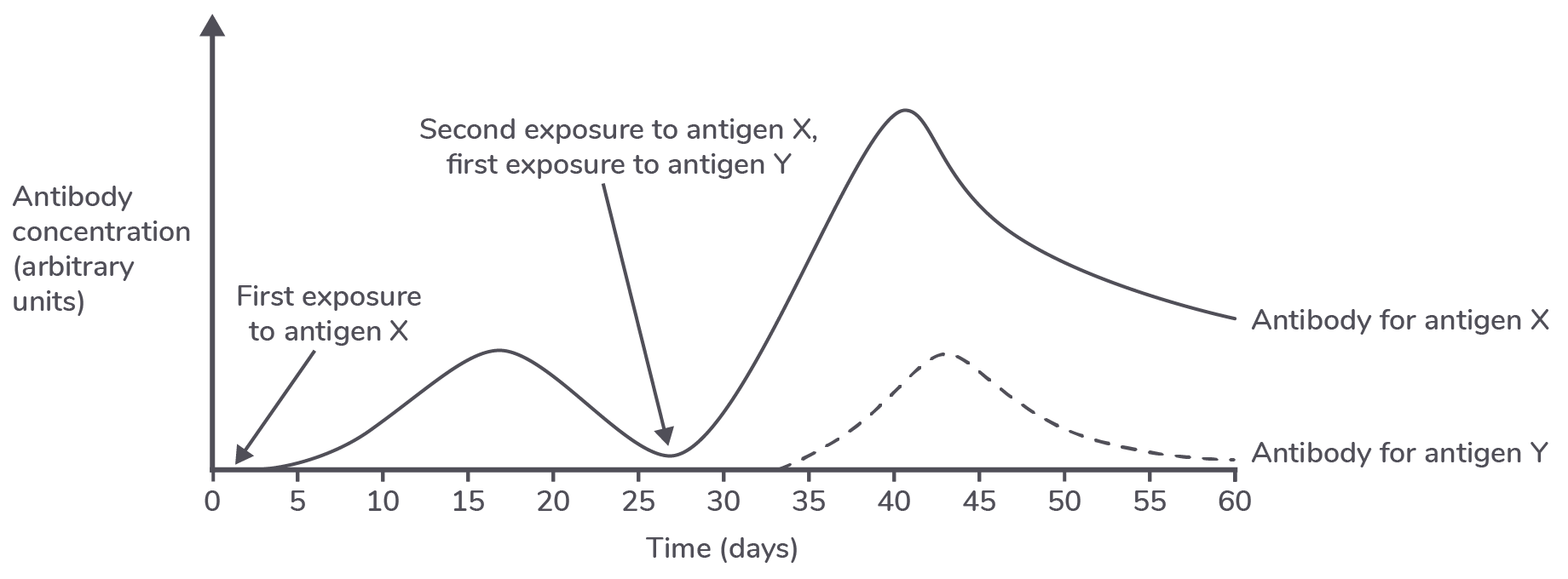
What is the explanation for the results displayed on the graph?
Question 11 of 11
11 of 11
Which plant disease is caused by a pathogen from the kingdom Protoctista?