Ecosystems - exam practice
Ecosystems
Question 1 of 13
1 of 13
Which group could be a population?
Question 2 of 13
2 of 13
What is the ecological definition of the term community?
Question 3 of 13
3 of 13
A tree carries out photosynthesis and provides organic compounds for other organisms in a forest.
It takes carbon dioxide from the atmosphere and returns oxygen to the atmosphere. It takes water from the soil into its roots and its leaves lose water to the atmosphere. Many other organisms live in the tree.
Which term describes the tree?
Question 4 of 13
4 of 13
The first stage of primary succession is the pioneer community.
Which of the following statements about a pioneer community are correct?
1 - species produce large numbers of wind-carried seeds or spores
2 - biomass is low
3 - many species are lichens and mosses
Question 5 of 13
5 of 13
Barnacles are small animals that live on rocky shores. Adult barnacles are fixed to rocks and do not move about. They catch passing food in the water with modified limbs called cirri when the tide comes in.
Chthalamus stellatus is a species of barnacle found around UK shores.
Two students wished to estimate the population size of C. stellatus on a rocky shore near their school.
What could the students use for estimating the C. stellatus population?
1 - an abundance scale, such as ACFOR
2 - quadrat sampling
3 - mark-release-recapture
Question 6 of 13
6 of 13
The nitrogen cycle involves a range of reactions and microorganisms.
Which process usually occurs under anaerobic conditions?
Question 7 of 13
7 of 13
A farmer grows a different crop in a field each year for three years. In the fourth year the farmer plants a leguminous crop and then ploughs this into the soil. The next year the rotation starts again.
Which microorganisms will increase by the time the rotation starts again?
1 - denitrifying bacteria
2 - nitrifying bacteria
3 - nitrogen-fixing bacteria
4 - decomposing bacteria
Question 8 of 13
8 of 13
Which soil would have the smallest number of denitrifying bacteria?
Question 9 of 13
9 of 13
Decomposition of organic matter can cause the concentration of ammonia to rise in a fish tank. High concentrations of ammonia in the tank are toxic to fish. Bacteria may be added to remove the ammonia.
Which type of bacteria should be added?
Question 10 of 13
10 of 13
Which processes are essential in making nitrogen in dead plant material available to growing plants?
1 - ammonification
2 - deamination
3 - nitrification
4 - nitrogen fixation
Question 11 of 13
11 of 13
Which bacteria convert ammonium compounds to nitrites?
Question 12 of 13
12 of 13
An insect consumes 180 J of plant material.
Of this, 95 J of energy is passed out in the insect’s faeces and 58 J is used for respiration.
Which percentage of the energy, in the original plant material taken in by the insect, is converted into biomass?
Question 13 of 13
13 of 13
The diagram shows the flow of energy through a food chain. Figures are in kJ m-2 year-1.
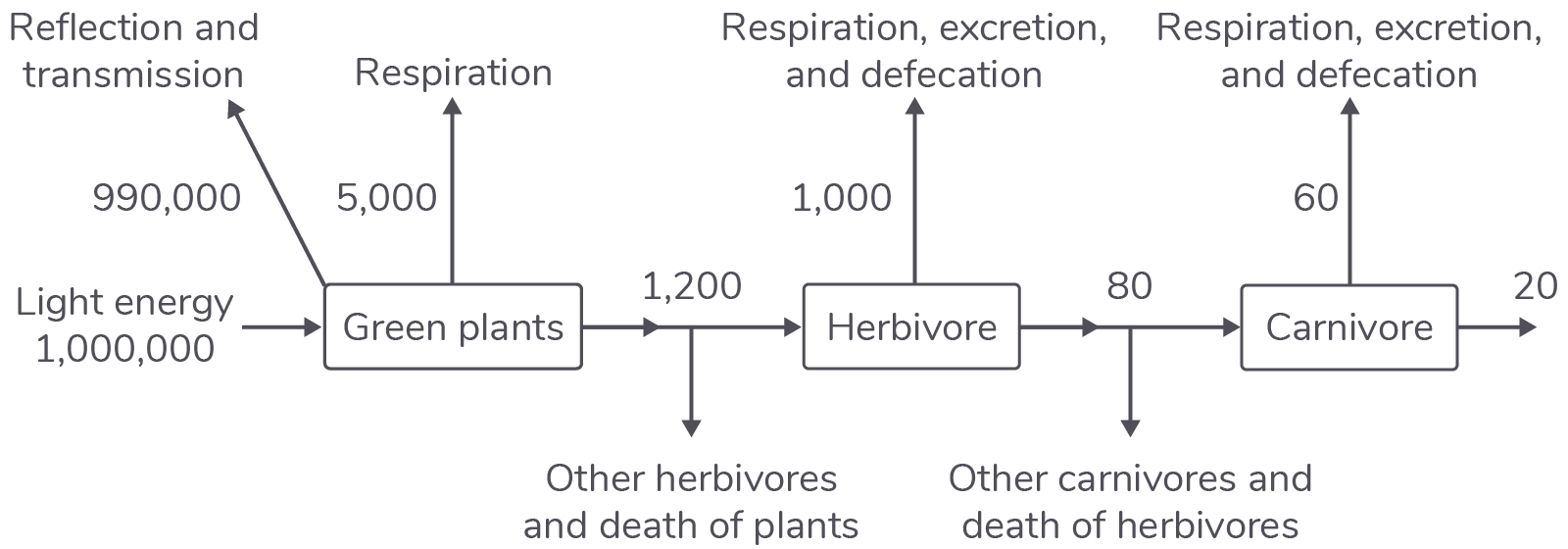
What percentage of light energy is available to the herbivore?