Cell Organisation & Specialisation - exam practice
Cell Organisation & Specialisation
Question 1 of 14
1 of 14
Some stem cells divide and give rise to phagocytes.
Where in the human body do these stem cells divide?
1 - blood
2 - bone marrow
3 - lymph nodes
Question 2 of 14
2 of 14
Which feature of stem cells enables them to replace cells in tissues such as the skin?
Question 3 of 14
3 of 14
Mesenchymal stromal cells (MSCs) are stem cells found in human wisdom teeth.
MSCs can differentiate into three cell types: chondrocytes, osteoblasts, and adipocytes.
To which category of stem cells do MSCs belong?
Question 4 of 14
4 of 14
Embryonic stem cells can be used in cell replacement therapies.
Embryonic stem cells can differentiate into any type of body cell but cannot form a whole organism.
What is the type of stem cell being described?
Question 5 of 14
5 of 14
Which statement is not true about adult stem cells?
Question 6 of 14
6 of 14
Which statement correctly explains why meristems can differentiate into xylem vessels in plant stems?
Question 7 of 14
7 of 14
Several cell types develop from haematopoetic stem cells in the bone narrow.
Which statement correctly describes haematopoetic stem cells?
Question 8 of 14
8 of 14
Rheumatoid arthritis is a long-term condition that causes pain, swelling, and stiffness in the joints.
What explains why stem cells are a potential source of treatment for rheumatoid arthritis?
Question 9 of 14
9 of 14
Sperm cells are an example of a specialised cell.
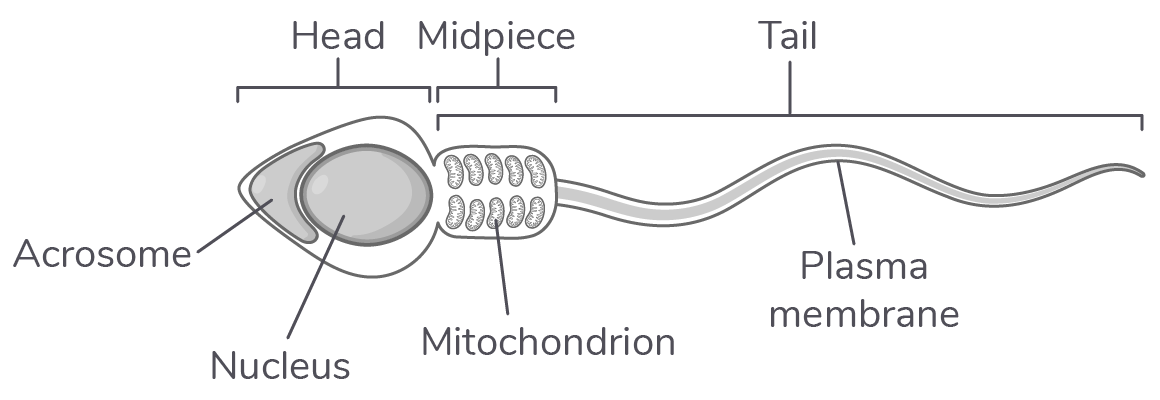
Which statement correctly describes one specialisation of a sperm cell?
Question 10 of 14
10 of 14
A student observed a stained blood smear using a light microscope and wrote the following description about one of the blood cells:
1 - large cell
2 - nucleus with three lobes stained dark blue
3 - cytoplasm stained pale blue
4 - cell-surface membrane present
Which blood cell is being described?
Question 11 of 14
11 of 14
Which animal cells would have the most Golgi apparatus?
Question 12 of 14
12 of 14
Which type of cell has a large number of glycoproteins on the cell-surface membrane?
Question 13 of 14
13 of 14
Which organelle is present in large quantities in ciliated epithelial cells?
Question 14 of 14
14 of 14
What is the potency of adult bone marrow stem cells?