18.4 - Random Sampling
- 1
What random sampling is
- 2
How to prevent sampling bias and reduce the effects of chance
- 3
Random sampling techniques for plants and animals
Random sampling
It is often impractical or impossible to measure every single individual when investigating population traits. Random sampling is important to avoid bias and ensure the samples are representative of the whole population.
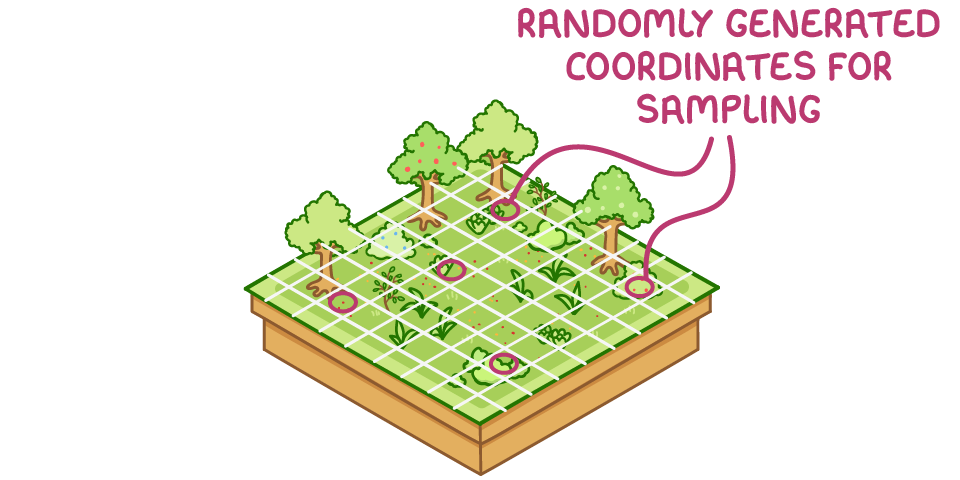
How random sampling works:
- Choose an area.
- Randomly generate coordinates across the area - This prevents sampling bias by removing human involvement in choosing samples.
- Collect samples from random coordinates - This gives us samples that are representative of the population.
- Repeat this several times - This gives us a large sample size and minimises the effects of chance.
- Analyse the data collected - This lets us identify any relationships.
Random sampling techniques
Once you have generated random coordinates, there are two main techniques you need to know that can be used to collect samples of plants and animals.
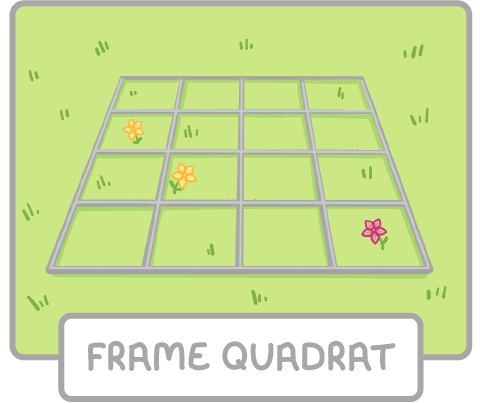
These techniques are:
- Pooter - This samples small insects by sucking air containing the insects into a plastic container via a tube.
- Quadrat - This is a frame used to sample plants or non-motile animals in an area.
How to sample biodiversity
Depending on the area and organisms being investigated, we can use the methods above to sample biodiversity of an area.
This can be done as follows:
- Choose an appropriate method (e.g. quadrats, pooters, etc.) depending on the habitat.
- Estimate the number of individuals of each species in a sample.
- Repeat sampling across habitat and take multiple samples for reliability.
- Estimate total number of individuals or species in the area.
Estimating the total number of individuals of a species
There are a few methods that can be used to estimate the total number of individuals of a species using quadrats.
- Species frequency
- Record the number of times a species is found in a quadrat.
- Record the number of samples taken in total.
- Calculate: species frequency =
- Species density
- Count the number of individuals of a species across all quadrats.
- Divide this value by the total area of all quadrats.
- Percentage cover
- Estimate the area within a quadrat that a plant species covers.
- Average this value across multiple quadrats.