Nervous Coordination in Animals - exam practice
Nervous Coordination in Animals
Question 1 of 7
The table below shows some statements about different neurones.
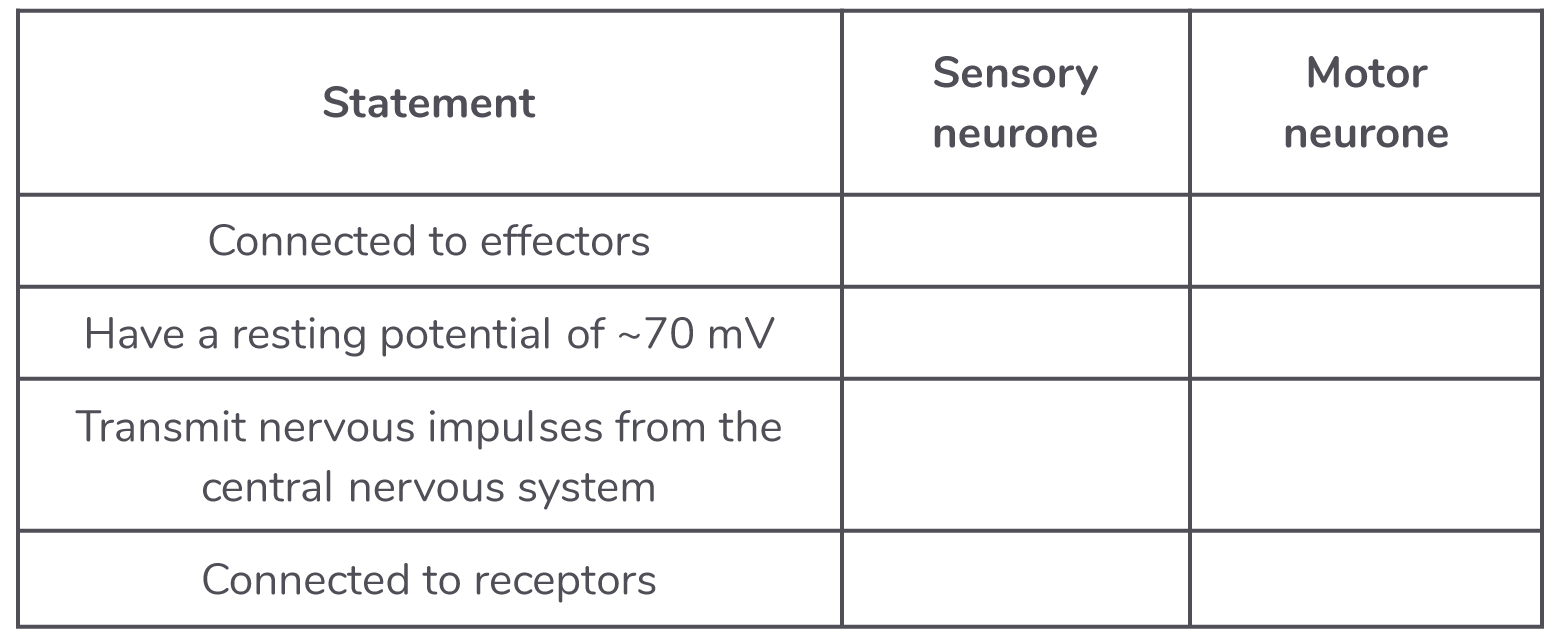
Complete the table by placing a tick if the statement is true for each neurone and a cross if it is not true.
Describe three similarities between the structure of sensory and motor neurones.
Describe two differences between the structure of sensory and motor neurones.
Multiple sclerosis (MS) is a disease that causes the loss of myelin around motor neurones.
Explain why the speed of nerve impulses is slower in people diagnosed with MS.
The statements below describe some of the events that take place during an action potential.
A - Sodium ions diffuse into the axon.
B - Potassium ions diffuse out of the axon.
C - Potassium ion channels open.
D - Sodium ion channels open.
E - Active transport of sodium ions and potassium ions.
Which of the events, A to E, starts depolarisation?
Which of the events, A to E, starts repolarisation?
Sodium and potassium ions can only cross the cell membrane through proteins.
Explain why.
Explain how a resting potential is established and maintained across the axon membrane of a neurone.
The diagram below shows how the voltage across the axon membrane changes during the generation and transmission of an action potential.
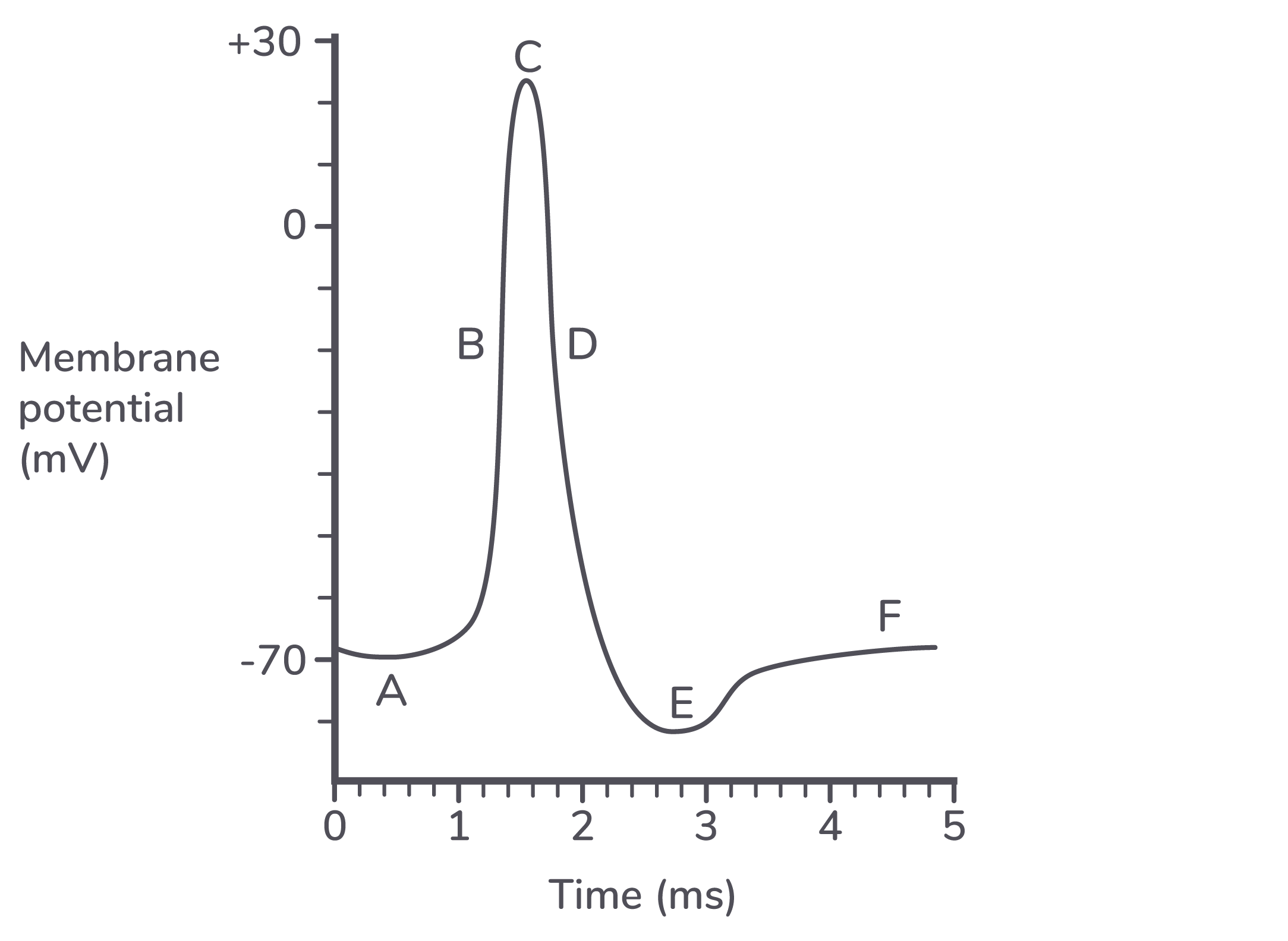
Which letters, A to F, show the point at which voltage-gated sodium ion channels are open?
Describe and explain what causes the change in membrane potential between points A and B.
Describe and explain what causes the change in membrane potential between points C and D.
Name period E on the diagram above and explain its importance in humans.
The diagram below shows a cross section through a myelinated neurone.
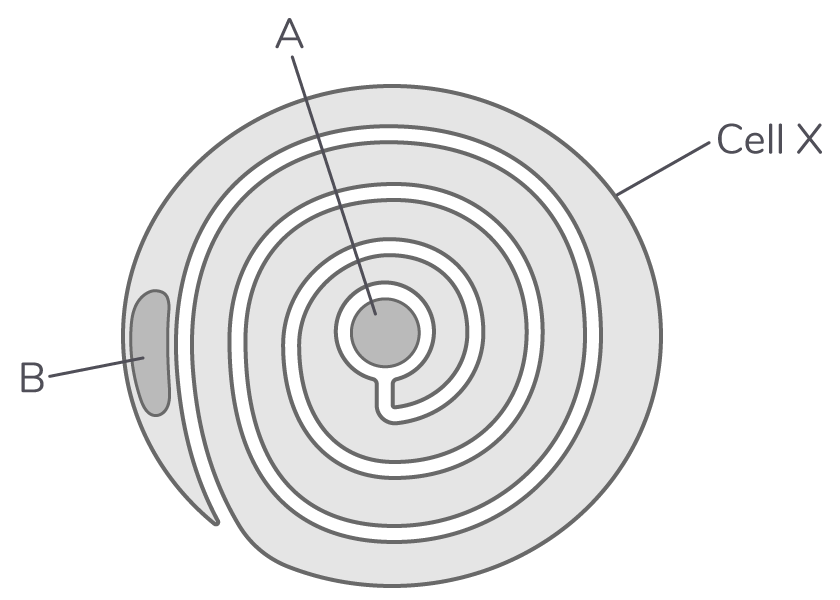
Name structures labelled A and B in the diagram above.
Name cell X shown in the diagram above.
Explain the importance of the myelin sheath in the transmission of action potentials.
Guillain-Barré syndrome is a very rare and serious condition affecting the myelin sheath of neurones.
Patients diagnosed with Guillain-Barré syndrome often experience muscular weakness and muscular paralysis.
Explain how damage to the myelin sheath may cause muscular paralysis.
The nervous system is made up of the central nervous system (CNS) and the peripheral nervous system (PNS).
Describe the roles of sensory receptor cells in the nervous system.
The central nervous system coordinates responses to changes in the environment.
Explain how nervous impulses are transmitted to muscles to bring about a response.
The production of action potentials follows the all-or-nothing principle.
Explain how this principle works.
Explain how the strength of a stimulus is communicated to the brain.
The diagram below shows the structure of a sensory neurone.
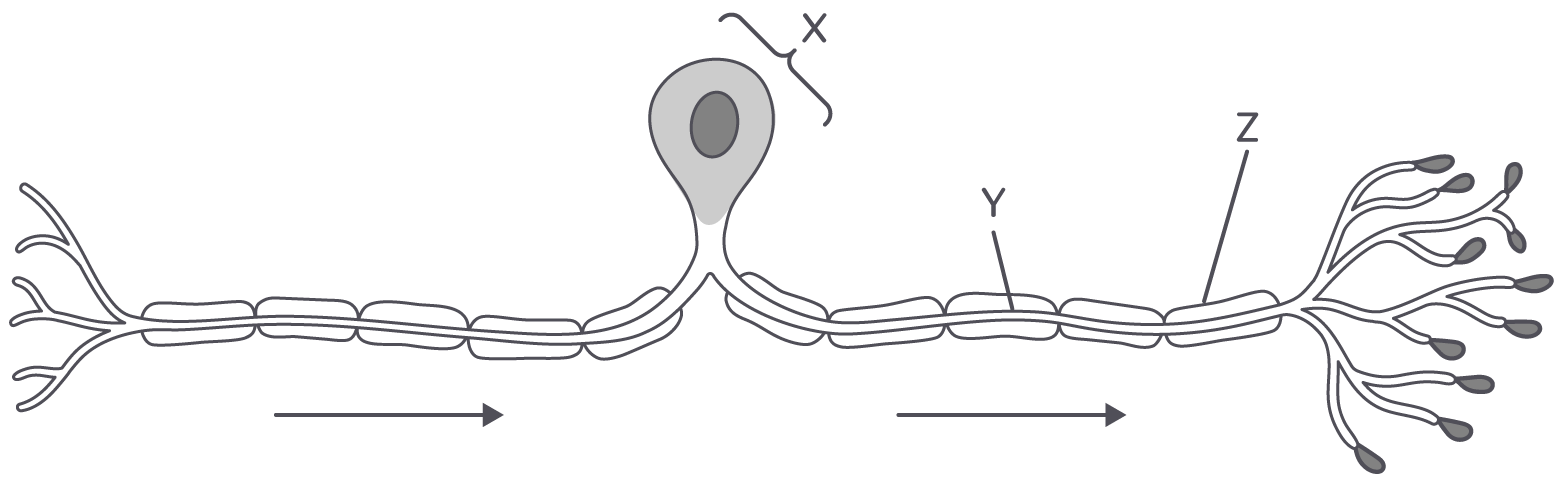
Name structures X, Y, and Z shown in the diagram above.
Describe how an action potential is generated in a sensory neurone.
The diagram below shows the changes in membrane potential of a receptor cell over a period of time.
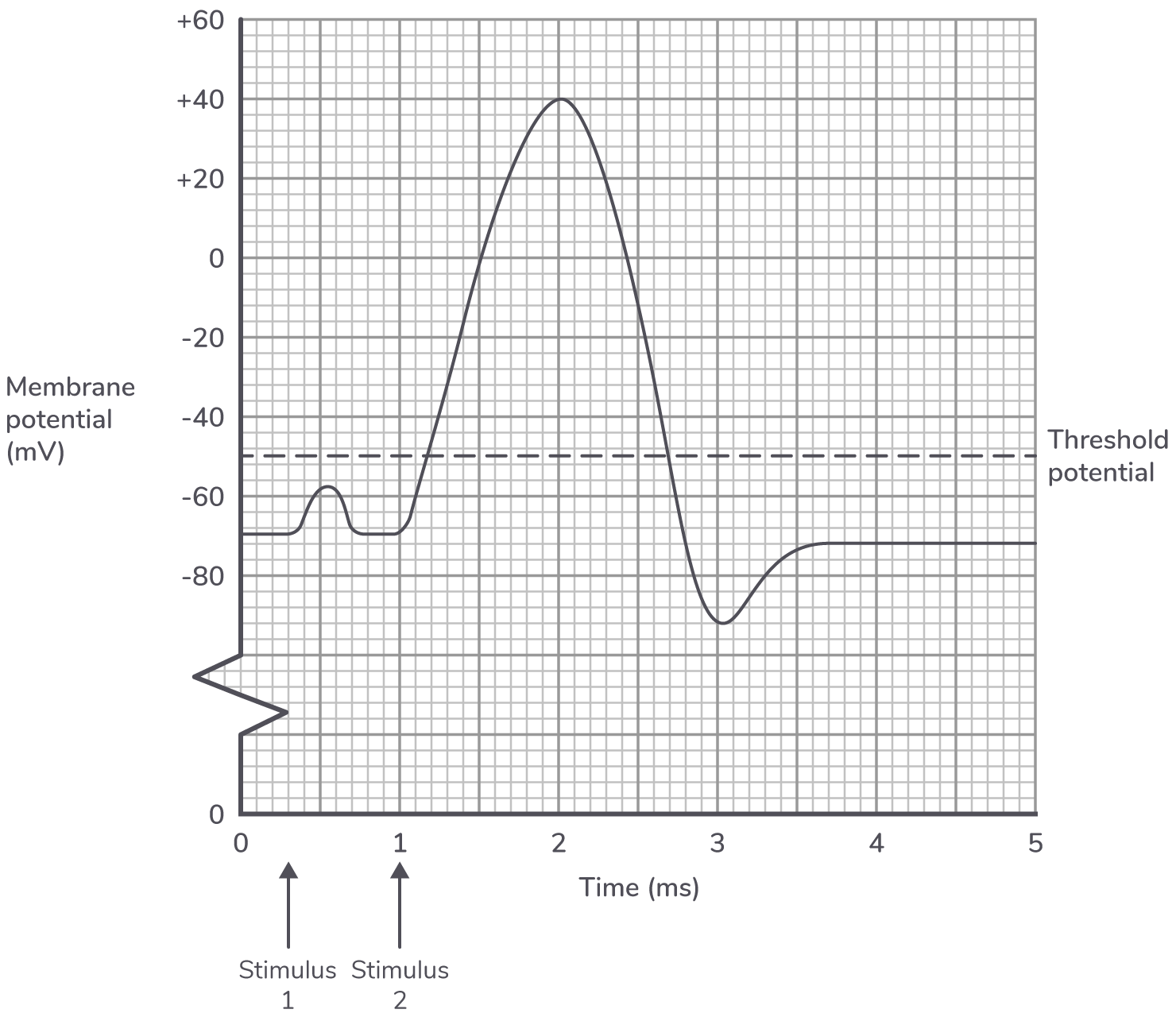
Explain why stimulus 2 caused an action potential, but stimulus 1 did not.
The period between 2.8 and 3.6 ms is known as the refractory period.
Describe what happens during the refractory period.
A group of scientists investigated the effect of length of time in an ice-cold water bath on the reaction times of mice.
They used 30 mice and measured the reaction times after being placed in an ice-cold water bath for 0, 10, 20, and 30 seconds.
Their results are shown below.
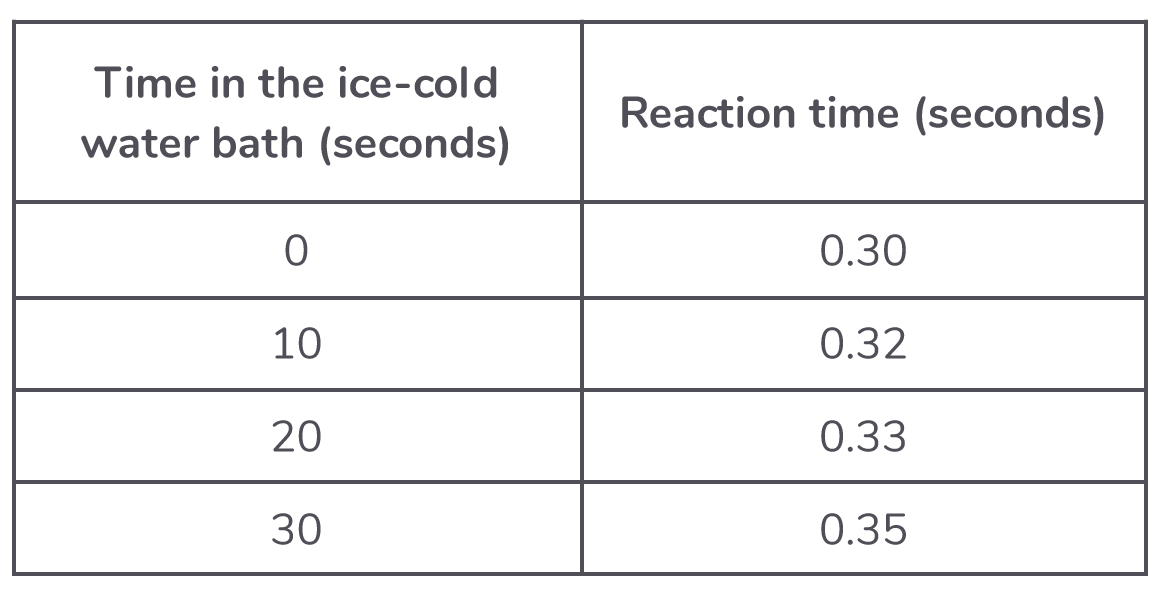
Suggest how the scientists would obtain results for 0 seconds.
Explain why a lower temperature results in slower nerve impulse transmission.
Nerve impulse conduction takes place faster across myelinated neurones than non-myelinated neurones.
Explain why.
Give one factor, other than temperature and myelination, that increases the speed of nerve impulse conduction.