Control & Coordination in Plants - exam practice
Control & Coordination in Plants
Question 1 of 5
A scientist investigated how IAA concentration affects the growth of young plants.
He removed the tip of the shoot from each plant and removed a 5 mm length of shoot.
He placed each shoot into a Petri dish with a glucose solution and a different concentration of IAA solution.
He left each dish in the dark for a week and then measured the length of each shoot.
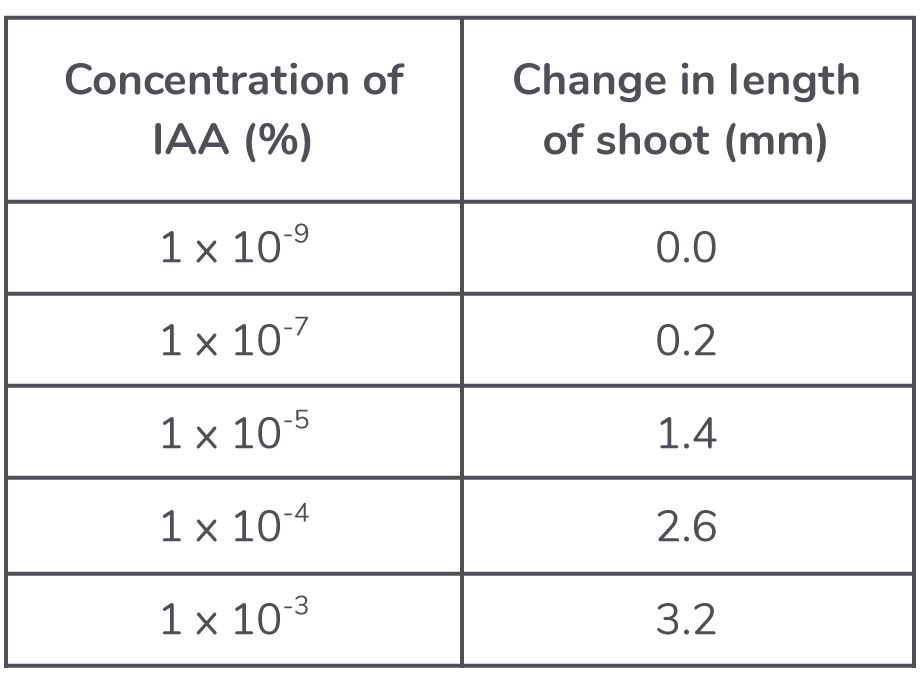
His results are shown in the diagram below.
Suggest why the scientist added glucose solution to each Petri dish.
Explain why the scientist removed the tip of the shoot from each plant.
Describe and explain the results shown in the table above.
Another scientist repeated the investigation using plant roots rather than shoots.
Predict the results he would obtain. Explain your answer.
Both animals and plants use hormones for cell signalling.
Describe two similarities between the action of plant and animal hormones.
Gibberellin is a type of plant hormone that causes an increase in the distance between the leaves on the stem (the internodal length).
State two other roles of gibberellin in plants.
Explain why gibberellin is considered a plant hormone.
A scientist investigated the effect of temperature on the uptake of IAA by leaves.
He sprayed a solution containing IAA onto the lower surface of a leaf at different temperatures.
His results are shown in the diagram below.
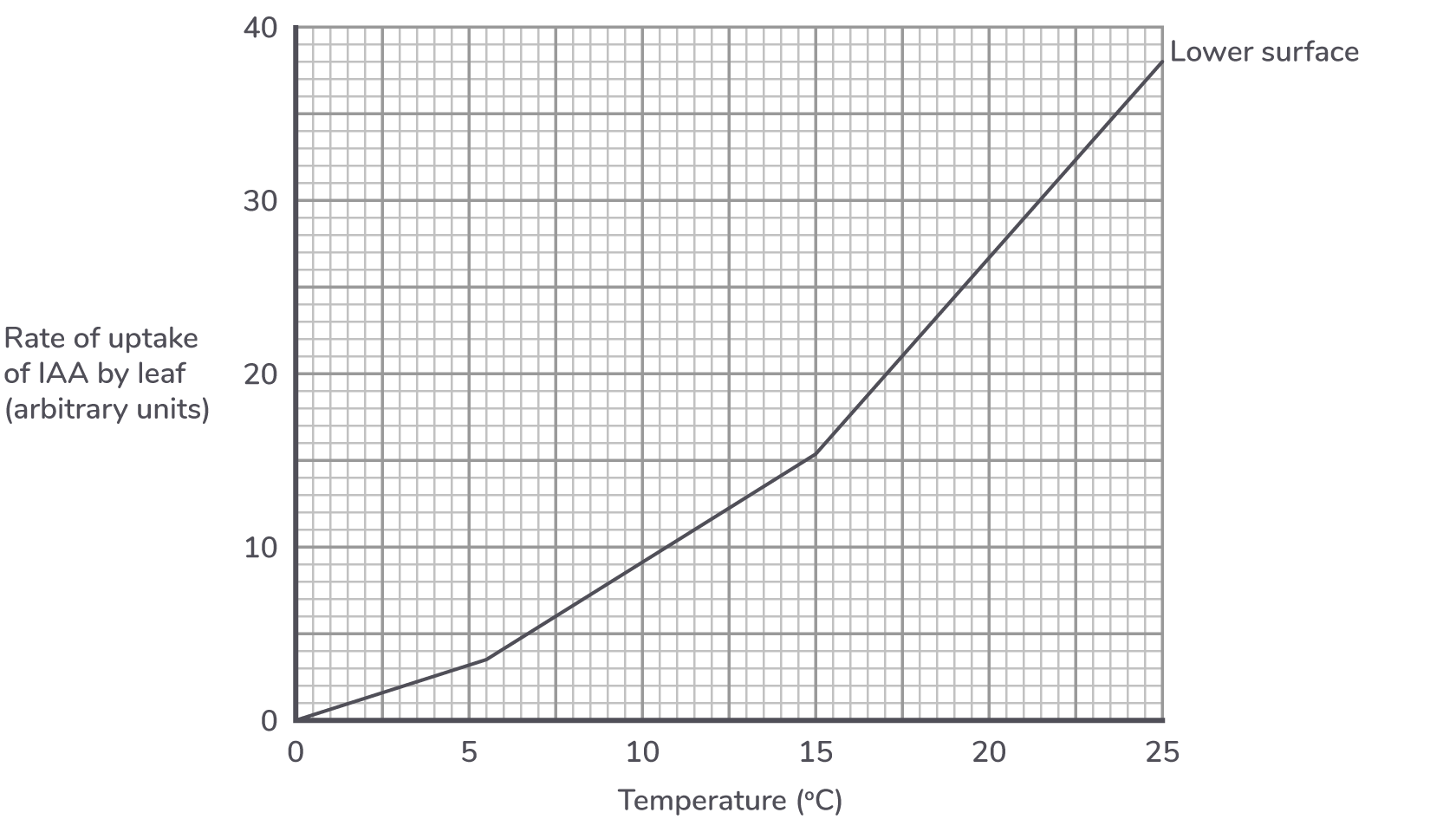
Describe and explain the results shown in the diagram above.
Another scientist repeated the same experiment instead spraying the solution onto the upper surface of the leaf.
They found that the rate of uptake was lower for all temperatures investigated.
Suggest and explain why.
Name the process by which IAA is transported from growing regions to other tissues in the plant.
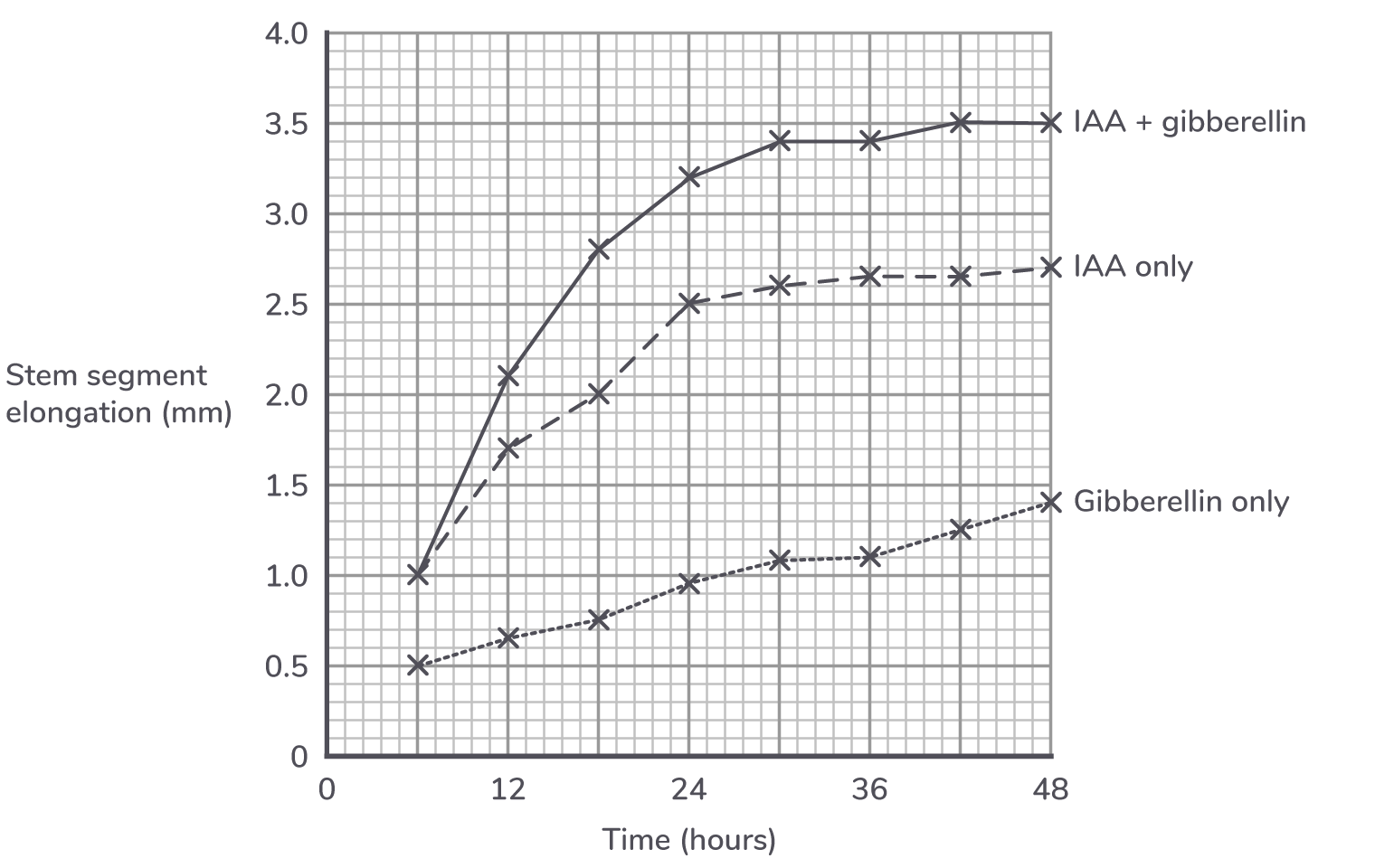
An experiment was carried out to investigate the effects of IAA and gibberellin on elongation of seedlings.
Internode sections of stems were used and received either IAA, gibberellin, or both hormones.
The results of this experiment are shown below.
Describe how a control experiment could have been carried out for this investigation.
Compare the effects of the three treatments on the elongation of the stems.
A group of scientists investigated the role of IAA in how plants respond to light.
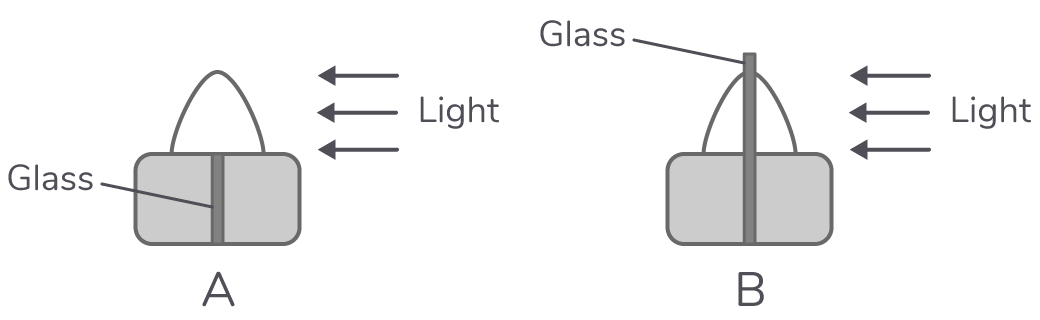
They cut the tip off the shoot from two seedlings and placed each shoot tip on a block of agar jelly.
They then used a piece of glass to separate the sides of the shoot as shown in the diagram below.
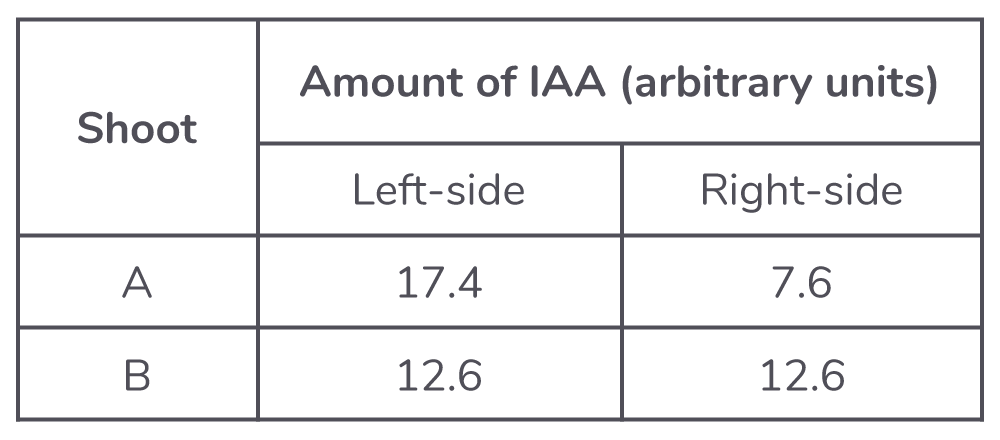
After 1 day, they measured the amount of IAA in the agar blocks.
Their results are shown in the table below.
The scientists did not use a control experiment in their investigation.
Describe how they could set up another shoot to ensure that any response by the shoots was due to the presence of light.
One of the scientists hypothesised that light causes IAA to move from the illuminated side to the shaded side.
Describe the evidence from their results that supports this hypothesis.