Infectious Diseases - exam practice
Infectious Diseases
Question 1 of 4
Most cases of cervical cancer are caused by infection with human papillomavirus (HPV).
This virus can be spread by sexual contact.
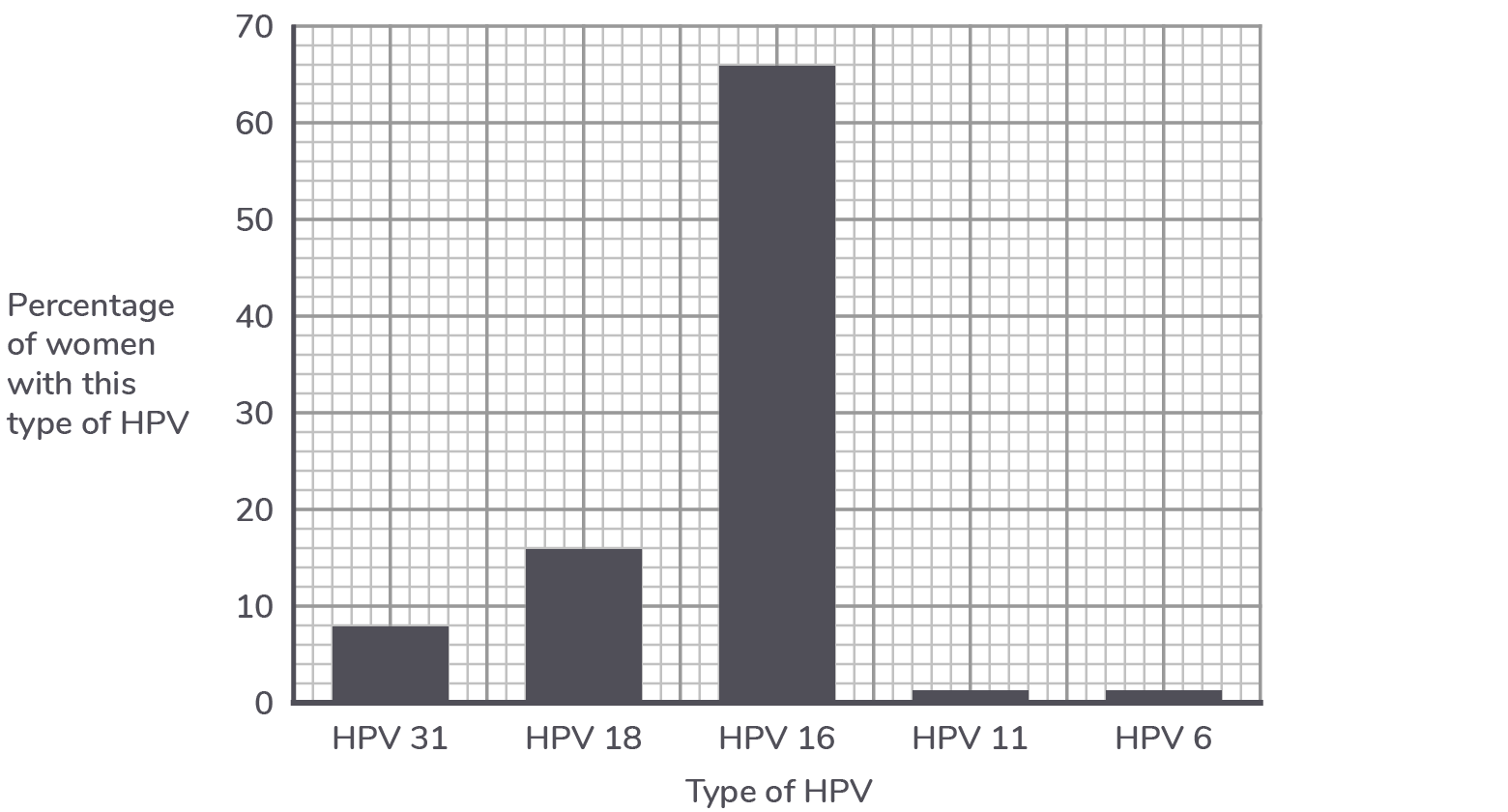
Scientists investigated the relationship between cervical cancer and infection with certain types of HPV.
The graph shows the frequency of five different types of HPV in women who had cervical cancer.
A vaccine made from HPV types 16 and 18 is offered to girls aged 12 to 13.
Suggest why these types are included in the vaccine, whereas others are not.
Explain why this vaccine may not protect individuals from HPV types 6, 11, and 31.
More recently, the vaccine has also been offered to young men.
Explain why.
Smear tests are offered to women in which abnormal cells in the cervix can be identified and removed before cervical cancer develops.
Explain why smear tests continue to be offered to vaccinated women.
Cholera and measles are both types of infectious diseases.
Cholera is an infection of the small intestine by Vibrio cholerae bacteria.
Measles is an airborne infection caused by a virus.
Some diseases can be treated with antibiotics.
Give two factors, other than cost, that need to be considered when choosing an antibiotic to treat a disease.
Antibiotics can be used to treat patients diagnosed with cholera.
Explain why antibiotics are not effective against measles.
Penicillin was an antibiotic originally used to treat meningitis.
However, strains of the bacteria that cause meningitis have become resistant to penicillin.
Describe how a population of bacteria can become resistant to penicillin.
Some strains of bacteria that cause meningitis are resistant to multiple antibiotics.
Discuss the consequences of this resistance for health authorities.
Tuberculosis (TB) and malaria are both examples of communicable diseases.
Name the pathogens that cause TB and malaria.
Describe how the pathogen causing TB is transmitted from one individual to another.
The malarial pathogen is carried by the female Anopheles mosquito.
Explain how mosquitoes transmit the malarial pathogen to humans.
Suggest why malaria is much more common in tropical areas of the world.
Tuberculosis (TB) and malaria are both examples of communicable diseases.
Name the types of pathogen that cause TB and malaria.
Describe how the pathogen causing TB is transmitted from one individual to another.
The malarial pathogen is carried by the female Anopheles mosquito.
Explain how mosquitoes transmit the malarial pathogen to humans.
Suggest why malaria is much more common in tropical areas of the world.