Fluid Mosaic Membranes & Transport - exam practice
Fluid Mosaic Membranes & Transport
Question 1 of 11
1 of 11
Membranes are found within and surrounding cells.
Which option is not a role of membranes in cells?
Question 2 of 11
2 of 11
Which statement is correct regarding active transport?
Question 3 of 11
3 of 11
The diagram represents the fluid mosaic model of membrane structure.
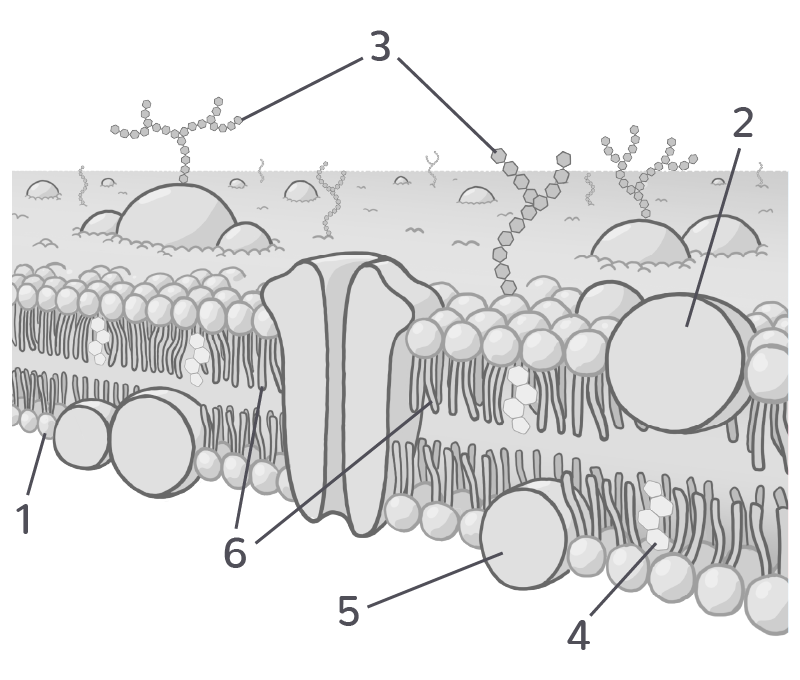
Which two components contribute to the fluidity of the membrane?
Question 4 of 11
4 of 11
What happens to an animal cell when it is placed in a solution with a more negative water potential?
Question 5 of 11
5 of 11
Which molecules in cell-surface membranes contribute to cell recognition?
Question 6 of 11
6 of 11
Which substances can pass directly through cell-surface membranes without using a carrier protein or channel protein?
1 - CO2
2 - Ca2+ and Na+
3 -H2O
Question 7 of 11
7 of 11
The cells in the roots of beetroot plants contain a red pigment. When pieces of root tissue are soaked in cold water, some red pigment leaks out of the cells into the water. The higher the temperature of the water, the higher the rate of loss of red pigment from the cells.
Which statement(s) could explain this trend?
1 - enzymes in the cells denature as the temperature increases, so pigment cannot be used for reactions in the cells and diffuses out
2 - as the temperature increases, the tertiary structure of protein molecules in the cell-surface membrane changes, increasing the permeability of the membrane
3 - phospholipid molecules gain kinetic energy as temperature rises, increasing the fluidity of the phospholipid bilayer and allowing pigment molecules to diffuse out more easily
Question 8 of 11
8 of 11
What describes a carrier protein in cell-surface membranes?
Question 9 of 11
9 of 11
Which statements about endocytosis are correct?
1 - it is part of phagocytosis
2 - it is a passive process
3 - materials are taken into the cell
4 - vesicles form within the cytoplasm
Question 10 of 11
10 of 11
When red blood cells are put into pure water they burst (haemolysis).
Which statements explain this haemolysis?
1 - the water potential of the surrounding liquid is lower than the water potential of the contents of the red blood cells
2 - the cell-surface membranes of red blood cells are not supported by cell walls
3 - more water moves into the red blood cells by osmosis than leaves the cells
4 - water enters the red blood cells by osmosis but does not leave the cells
Question 11 of 11
11 of 11
Four agar blocks are stained green using universal indicator and suspended in 1 mol dm-3 hydrochloric acid.
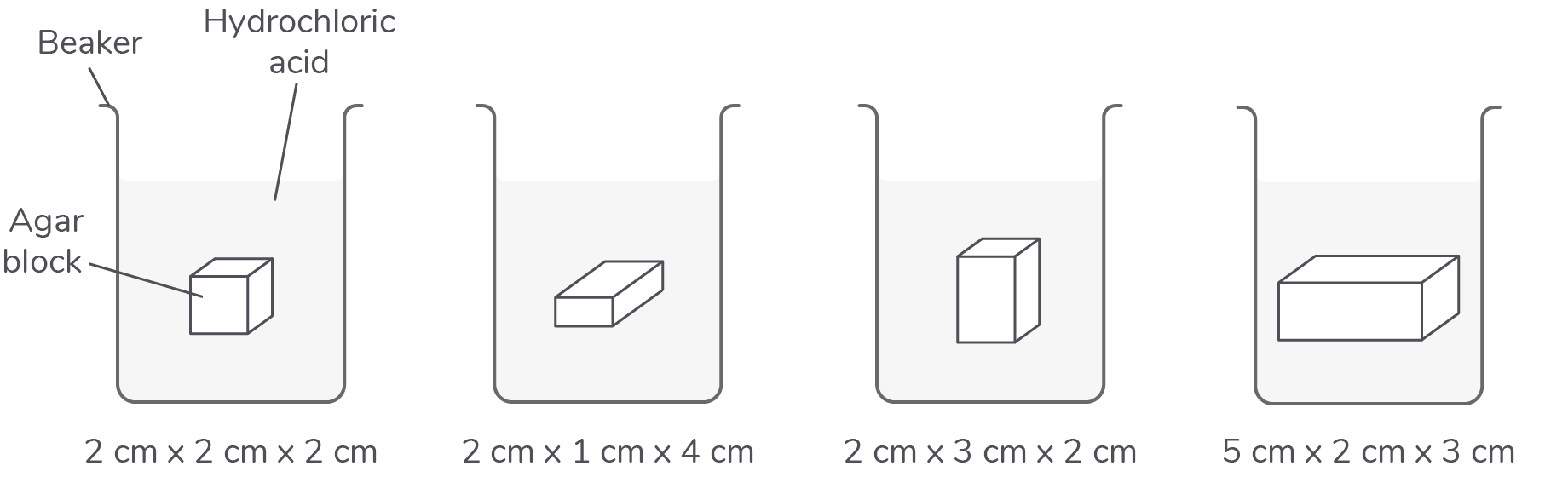
The time taken for the agar blocks to change from green to red was recorded.
Which agar block would be the first to become completely red?