The Gas Exchange System - exam practice
The Gas Exchange System
Question 1 of 10
1 of 10
Which statements about bronchioles are correct?
1 - they have ciliated cells
2 - they have goblet cells
3 - they have muscle tissue
Question 2 of 10
2 of 10
Air moves in and out of human lungs through the trachea, which is lined with cells. The diagram below shows a section containing these cells.
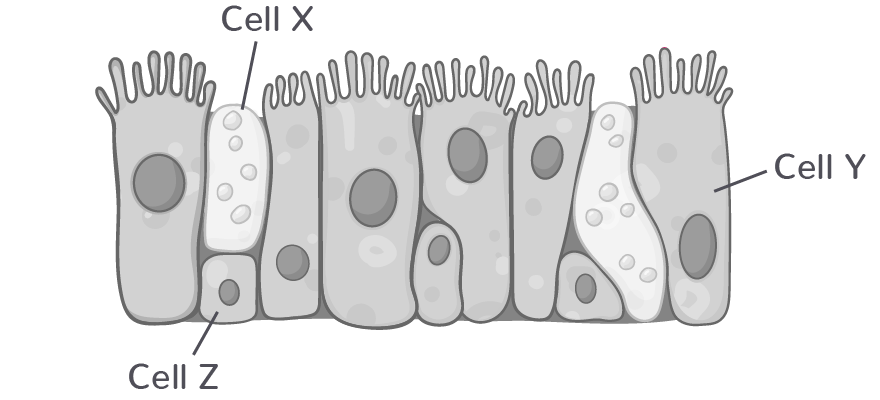
Which statement about tracheal cells is correct?
Question 3 of 10
3 of 10
Which characteristic of the human gaseous exchange surface and the lungs maintains the necessary concentration gradients for carbon dioxide and oxygen?
Question 4 of 10
4 of 10
Which tissues may be found in bronchioles?
Question 5 of 10
5 of 10
What would be seen in an electron micrograph of a bronchus wall?
1 - cartilage cells
2 - ciliated cells
3 - exocytotic vesicles
Question 6 of 10
6 of 10
Which does not increase the efficiency of gaseous exchange in the alveoli?
Question 7 of 10
7 of 10
Which statement correctly explains a feature of an efficient gaseous exchange surface?
Question 8 of 10
8 of 10
An oxygen molecule diffuses from the air in an alveolus through cells to haemoglobin in a red blood cell.
What is the minimum number of cell-surface membranes through which this molecule must pass?
Question 9 of 10
9 of 10
Which statements about the human gas exchange system are correct?
1 - the absence of cartilage in small bronchioles allows them to expand
2 - the walls of the alveoli are made of cuboidal epithelium
3 - alveoli secrete surfactant which reduces surface tension in the lungs
4 - the trachea and bronchi are supported by circles of cartilage
Question 10 of 10
10 of 10
Which structure does not have smooth muscle tissue in its walls?