Cells as the Basic Units of Living Organisms - exam practice
Cells as the Basic Units of Living Organisms
Question 1 of 11
1 of 11
Which of the following statements describes an organelle that is not membrane bound?
Question 2 of 11
2 of 11
Which organelle is not involved in the production and secretion of enzymes in eukaryotes?
Question 3 of 11
3 of 11
Which of the following cell structures are present in prokaryotic cells?
Question 4 of 11
4 of 11
Which structures are found in both animal and plant cells?
1 - cell wall
2 - cell membrane
3 - nucleolus
4 - chloroplasts
Question 5 of 11
5 of 11
Which of these cell components contain ribosomes?
1 - chloroplast
2 - mitochondrion
3 - smooth endoplasmic reticulum
4 - cytoplasm
Question 6 of 11
6 of 11
The following are all features of eukaryotic cells:
1 - chloroplast
2 - endoplasmic reticulum
3 - lysosome
4 - mitochondrion
5 - nucleus
Which of these structures have a double membrane?
Question 7 of 11
7 of 11
What is the function of nucleoli?
Question 8 of 11
8 of 11
Which statements about a typical eukaryotic cell are correct?
1 - it is smaller than 2µm
2 - it has a nucleolus
3 - it has linear DNA
4 - it only has small (70S) ribosomes
Question 9 of 11
9 of 11
Where would cisternae be found in a cell?
1 - endoplasmic reticulum
2 - Golgi apparatus
3 - mitochondrion
Question 10 of 11
10 of 11
Which structures are found in both chloroplasts and mitochondria?
1 - 70S ribosomes
2 - 80S ribosomes
3 - circular DNA
Question 11 of 11
11 of 11
The diagram shows a high-power drawing of a bacterium.
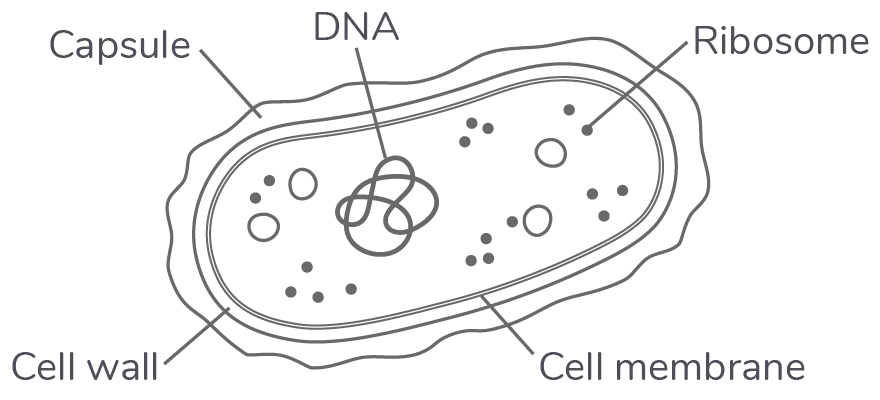
Which three components are found in both this bacterium and an animal cell?