Carbohydrates & Water - exam practice
Carbohydrates & Water
Question 1 of 14
1 of 14
Lactose is formed by a reaction between glucose and galactose, both of which have the chemical formula C6H12O6.
Which option shows the correct chemical formula for lactose?
Question 2 of 14
2 of 14
Carbohydrates, such as starch, are made from monosaccharides joined together.
Which bond joins monosaccharides together?
Question 3 of 14
3 of 14
What can occur during condensation of carbohydrates?
Question 4 of 14
4 of 14
What occurs when sucrose is broken down to monosaccharides?
Question 5 of 14
5 of 14
X and Y show the structures of two hexose sugars.
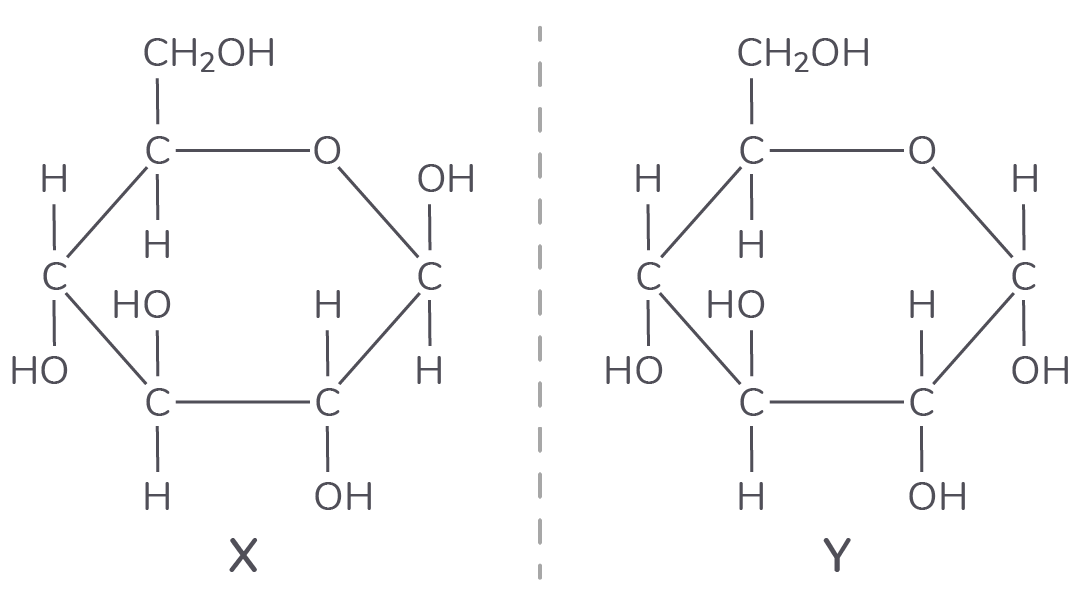
Which statement is correct?
Question 6 of 14
6 of 14
A sample of milk is tested with Benedict’s solution. After boiling, a yellow colour is observed.
Which conclusion is correct?
Question 7 of 14
7 of 14
Which carbohydrate gives a brick red colour when boiled with Benedict’s solution?
Question 8 of 14
8 of 14
Tests were performed on samples from a mixture of biological molecules.
When iodine in potassium iodide solution was added to a sample, the mixture turned black.
When the biuret test was carried out on another sample, the mixture turned purple.
Which biological molecules were in the mixture?
Question 9 of 14
9 of 14
The structure of a biological molecule is shown below.
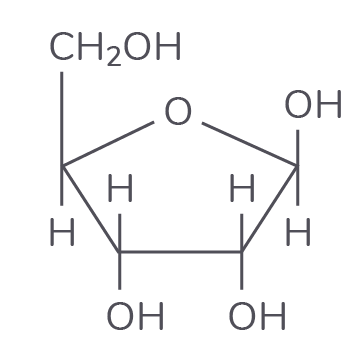
Which option correctly describes the molecule?
Question 10 of 14
10 of 14
An unknown solution of a single sugar was tested. After Benedict's test for reducing sugars, the colour observed was blue. After Benedict's test for non-reducing sugars, the colour observed was brick red.
Identify the unknown sugar.
Question 11 of 14
11 of 14
Why may fish living in ponds survive temperatures below 0°C in winter?
Question 12 of 14
12 of 14
Polar molecules form hydrogen bonds with each other.
Which properties of water result from its molecules being polar?
1 - good solvent
2 - high specific heat capacity
3 - high surface tension
4 - cohesive
Question 13 of 14
13 of 14
Which properties of water are important for transport in xylem?
1 - cohesion
2 - adhesion
3 - high energy requirement for evaporation
4 - good solvent properties
Question 14 of 14
14 of 14
A student wrote the following statement:
‘Water is polar because the oxygen side of the molecule is slightly positive in charge.’
Which option explains why this statement is not correct?