1.5 - Carbohydrates: Tests
- 1
The difference between reducing sugars and non-reducing sugars
- 2
How to test for reducing sugars (Benedict's reagent)
- 3
How to test for non-reducing sugars
- 4
How to test for starch (iodine)
Testing for reducing sugars
All sugars can be grouped into two categories.
These categories are reducing sugars and non-reducing sugars:
- Reducing sugars include all monosaccharides and some disaccharides such as maltose and lactose.
- Non-reducing sugars include some disaccharides such as sucrose and all polysaccharides.
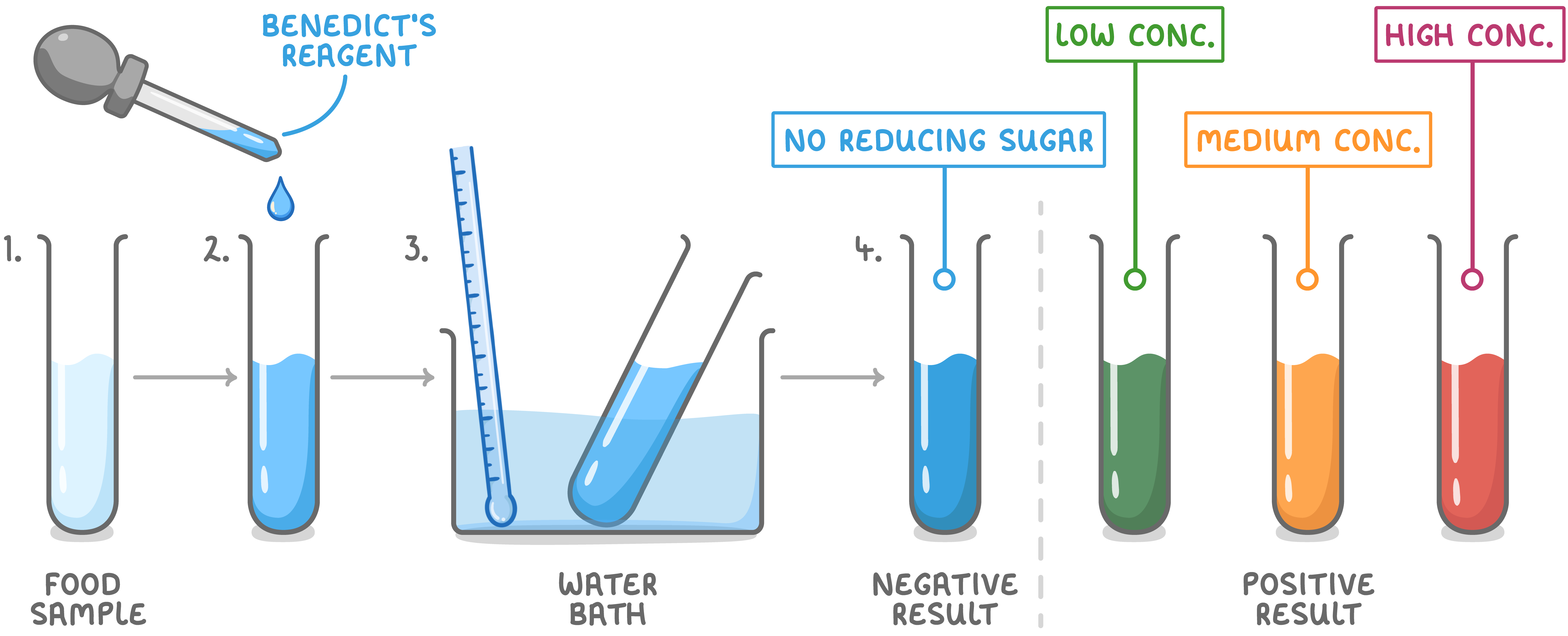
Steps to find out whether a sample contains a reducing sugar:
- Place 2 cm3 of your food sample into a test tube.
- Add an equal volume of Benedict's reagent.
- Heat the mixture in a gently boiling water bath for 5 minutes.
- If a reducing sugar is present, the mixture will change from a blue solution to a brick red precipitate.
Determining the concentration of reducing sugars
A positive result will form a brick red precipitate, however the colour seen is a mixture of the precipitate and the blue Benedict's reagent.
The concentration of reducing sugar determines the colour of this mixture:
- Blue - This indicates no reducing sugar is present.
- Green - This indicates a low concentration.
- Orange - This indicates a medium concentration.
- Brick-red - This indicates a high concentration.
This allows you to compare the concentration of reducing sugar between different samples.
Quantitative methods to determine concentration of reducing sugars
More accurate methods for comparison:
- Use a colorimeter to measure the absorbance of each solution.
- Filter the solution and weigh the precipitate.
Testing for non-reducing sugars
Non-reducing sugars give a negative result (blue solution) for the normal reducing sugars test. To test for these types of sugars, you must first hydrolyse them into their monosaccharide components before we can do the rest of the test.
Steps to find out whether a sample contains a non-reducing sugar:
- Carry out the test for reducing sugars, and if the result is negative (turns blue), continue with the next steps.
- Add 2 cm3 of the food sample to 2 cm3 of dilute hydrochloric acid.
- Heat the mixture in a gently boiling water bath for 5 minutes (the acid will hydrolyse disaccharides into monosaccharides).
- Neutralise the mixture by adding sodium hydrogencarbonate solution.
- Retest this mixture using the test for reducing sugars.
- If non-reducing sugars were present at the start, the mixture will now change from a blue solution to a brick red precipitate.
Testing for starch

To find out if a sample contains starch, you must carry out the iodine test.
Steps to find out whether a sample contains starch:
- Place 2 cm3 of your food sample into a test tube.
- Add a couple of drops of iodine solution and shake.
- If starch is present, the solution will turn from orange to blue-black.