4.1 - Structure of the Cell Membrane
- 1
The role of cell membranes in living organisms
- 2
The fluid-mosaic model of cell membranes
- 3
The structure and function of cell membrane components
Fluid-mosaic model
In 1972, the fluid-mosaic model was proposed to describe the structure of cell membranes:
- Fluid - Phospholipids form a bilayer in which the phospholipid molecules are constantly moving.
- Mosaic - There are proteins of different sizes and shapes embedded in the phospholipid bilayer (so it looks a bit like a mosaic).
Structure of the membrane

Key components of cell membranes:
- Phospholipid bilayer - This is made up of phospholipids with hydrophilic heads and hydrophobic tails.
- Cholesterol - This adds stability.
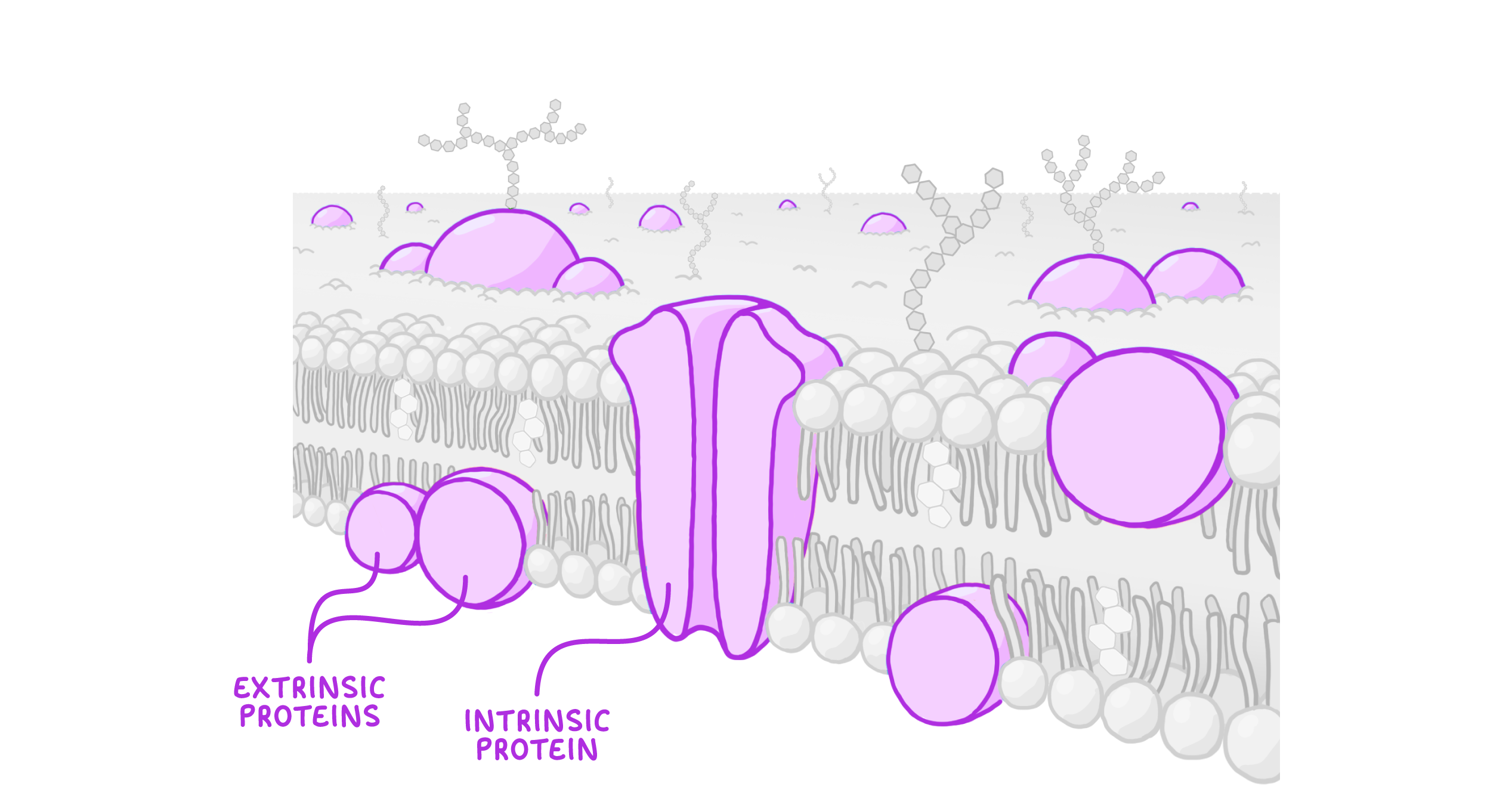
- Proteins - These may be intrinsic and extrinsic proteins.
- Glycoproteins - These are proteins attached to a carbohydrate.
- Glycolipids - These are lipids attached to a carbohydrate.
Phospholipid bilayer
Each phospholipid molecule is made up of a hydrophilic 'head' and a two hydrophobic 'tails'.
This causes phospholipids to arrange themselves into a bilayer so that the hydrophilic heads are facing out (towards water) and the hydrophobic tails are facing in (away from water).
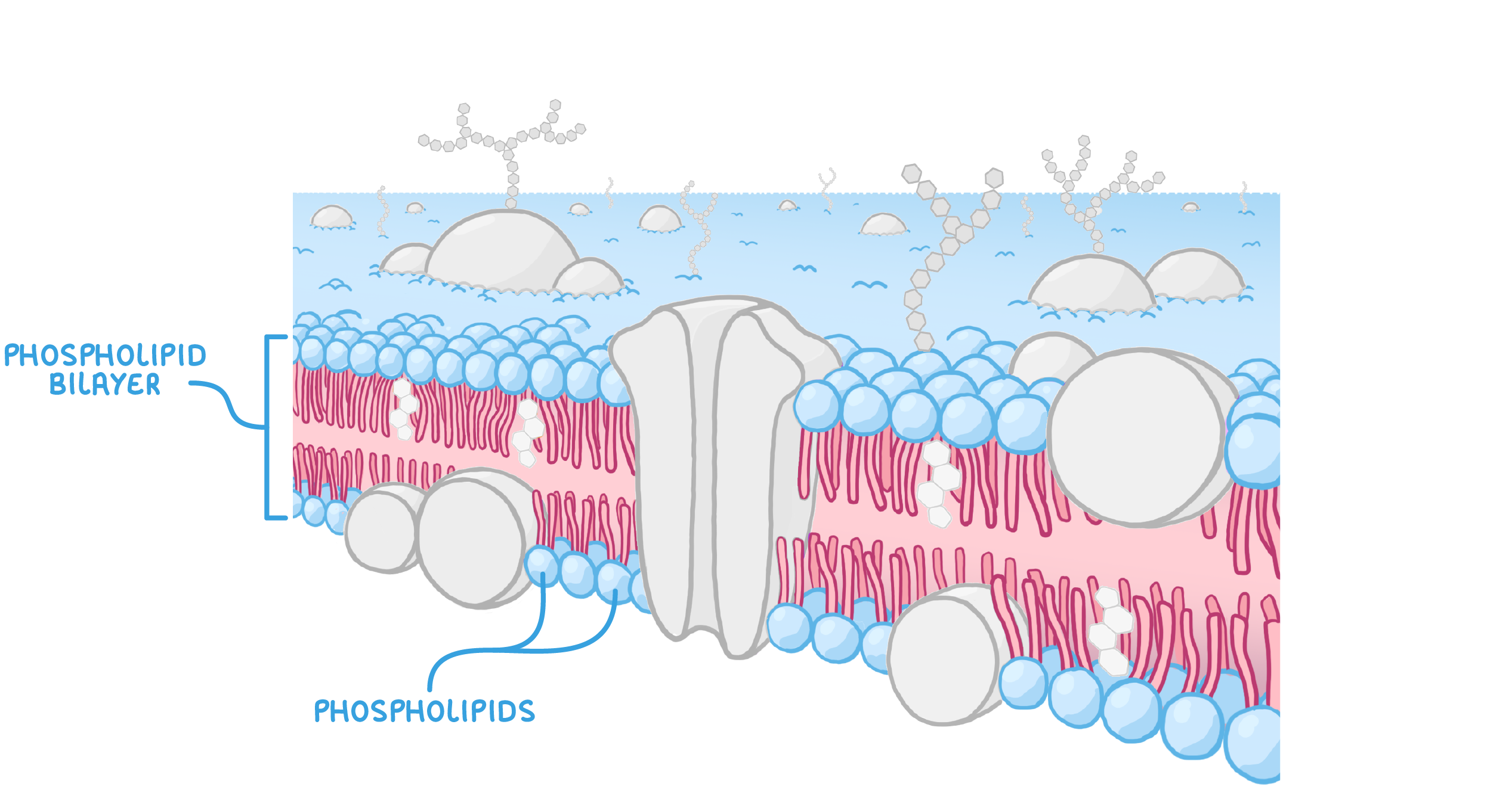
This arrangement creates a hydrophobic centre in the bilayer so that water-soluble substances cannot pass through.
However, lipid-soluble substances can dissolve in the bilayer and pass directly through the cell membrane.
Cholesterol
Cholesterol molecules provide stability to cell membranes.
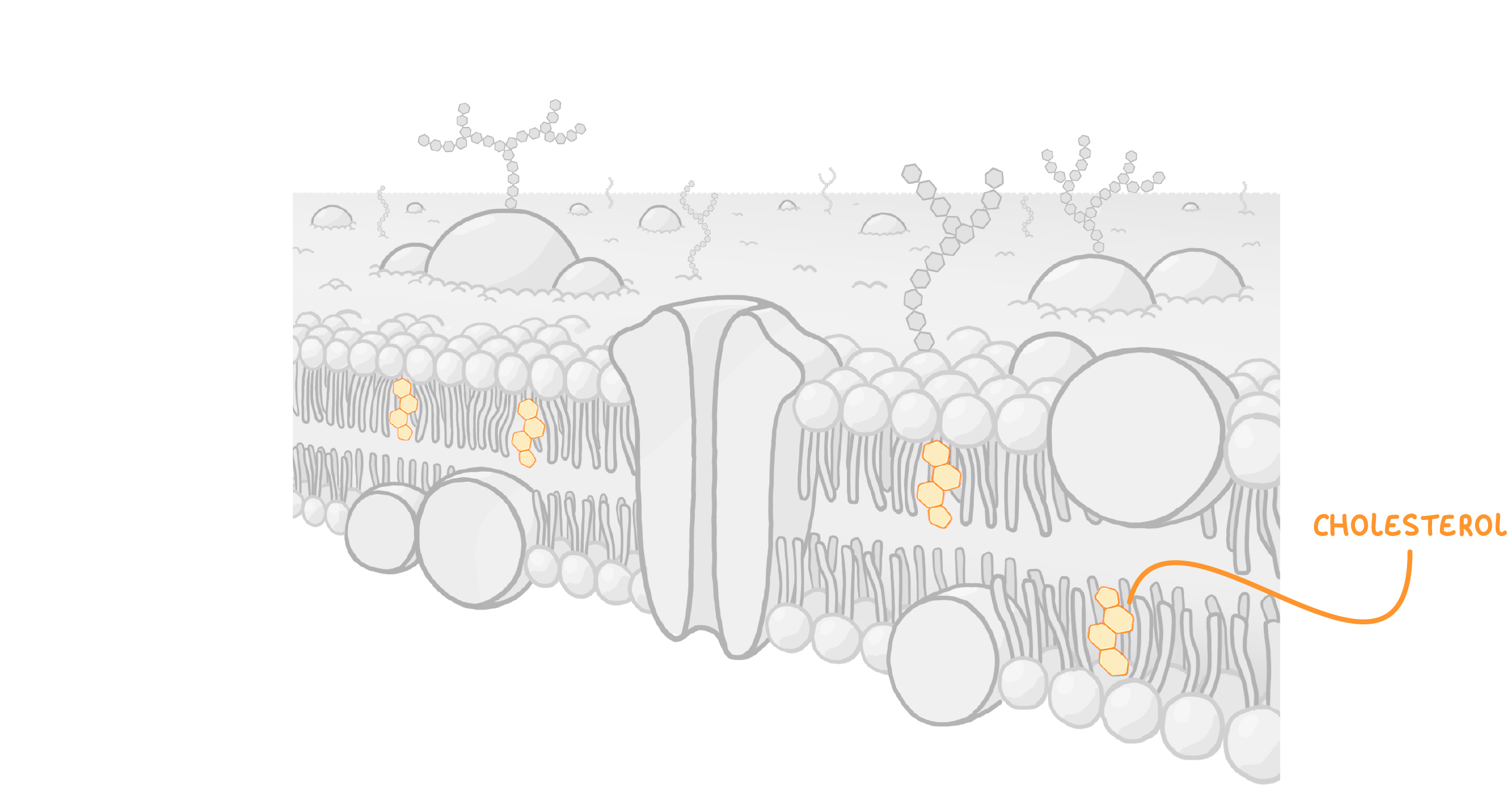
Cholesterol molecules consist of a hydrophilic and hydrophobic region. The hydrophobic regions bind to phospholipid fatty acid tails, causing them to pack more closely together.
This reduces the fluidity of the cell membrane.
Proteins
Proteins in cell membranes can be grouped into two categories: intrinsic and extrinsic proteins.
Intrinsic proteins:
- Intrinsic (or integral) proteins are embedded through both sides of the phospholipid bilayer.
- These proteins include channel and carrier proteins which transport large molecules and ions across the membrane.
Extrinsic proteins:
- Extrinsic (or peripheral) proteins are present on only one side of the phospholipid bilayer.
- These proteins provide support to the membrane or may be involved in cell signalling.
Glycoproteins and glycolipids
Glycoproteins consist of intrinsic proteins attached to carbohydrates, whereas glycolipids consist of lipids attached to carbohydrates.

Glycoproteins and glycolipids are involved in the following:
- Cell adhesion - This is the attachment of cells to one another.
- Cell recognition - This allows cells to recognise one another.
- Cell signalling - This is communication between cells.
Roles of cell membranes
There are two main types of cell membrane:
- Cell-surface membranes - These surround cells to act as a barrier between the cell and its environment, controlling which substances enter and leave the cell.
- Membranes around organelles - These surround organelles (e.g. mitochondria) to act as a barrier between the organelle and the cytoplasm, dividing the cell into different compartments (this is sometimes called compartmentalisation).
Both types of membrane are partially permeable, meaning they let some molecules pass through, but not others.