1.2 - Carbohydrates: Introduction
- 1
The elements that carbohydrates contain
- 2
The role of carbohydrates in living organisms
- 3
The different types of carbohydrates
What are carbohydrates?
Carbohydrates are biological molecules that contain the elements carbon (C), hydrogen (H), and oxygen (O).
- 'Carbo' - Contains the element carbon.
- 'Hydrate' - Contains hydrogen and oxygen atoms, typically in a ratio of 2:1 like water (H2O) in most simple carbohydrates.
The general formula for a carbohydrate is Cx(H2O)y.
Roles of carbohydrates
Functions of carbohydrates in living organisms:
- Energy supply for cells - This is the main role of carbohydrates.
- Energy storage - Sugars can be stored as complex carbohydrates (e.g. starch or glycogen).
- Structural components - Cellulose and chitin are used in cell walls.
- Cellular recognition - Glycoproteins help cells identify each other and communicate.
- Building blocks for biological molecules - Deoxyribose and ribose can be used to make nucleic acids.
Types of carbohydrates
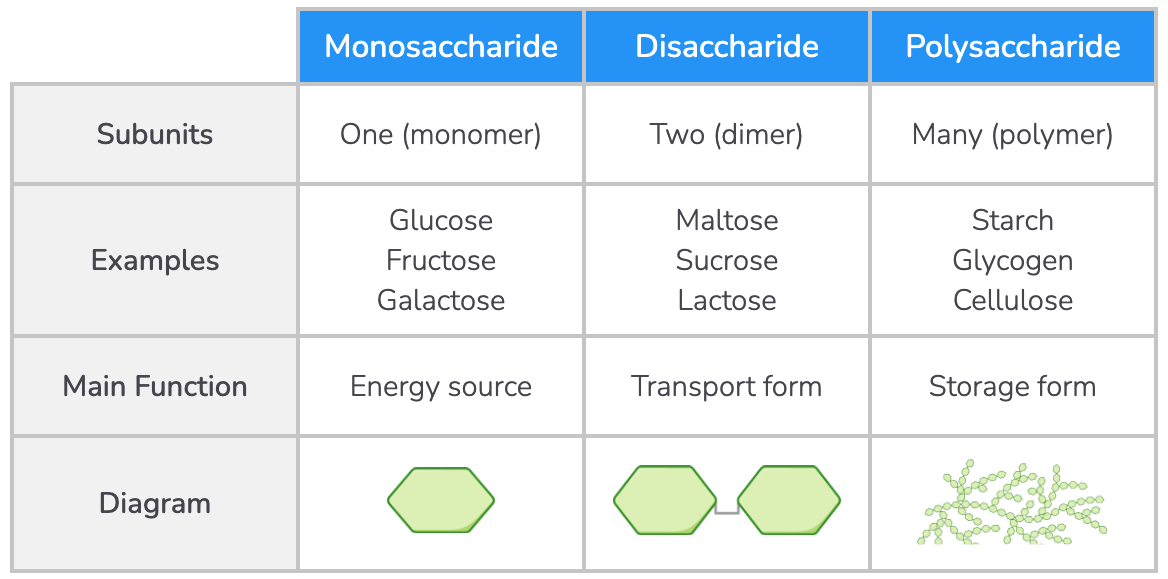
There are three types of carbohydrates: monosaccharides, disaccharides, and polysaccharides.
1.3 - Carbohydrates: Monosaccharides & DisaccharidesNext up
How were these notes?