Proteins - exam practice
Proteins
Question 1 of 5
Proteins are made up of monomers known as amino acids. The diagram below shows the structure of the amino acid serine.
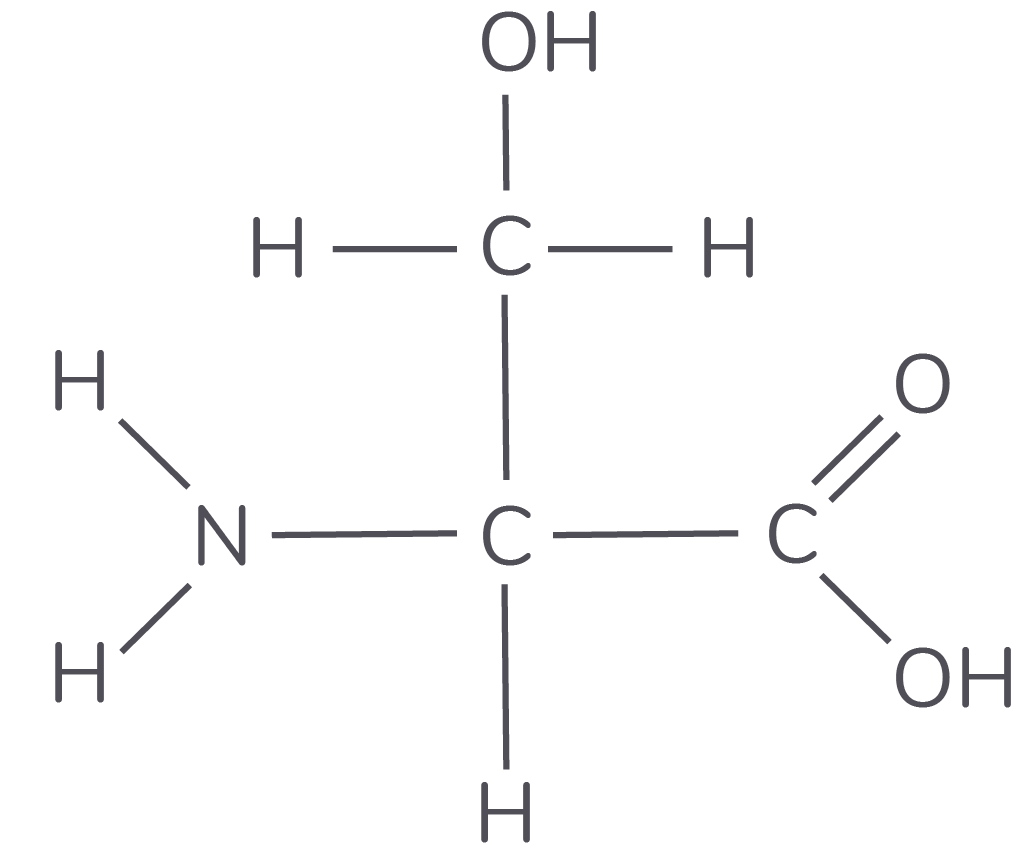
Draw a rectangle around the R group
Two amino acids can join together to form a dipeptide. Describe how.
Dipeptides consist of two amino acids joined together, however they may consist of different amino acids. Give two other similarities and one other difference between dipeptides.
Describe how you could test a food sample for protein.
Proteins consist of primary, secondary, tertiary, and quaternary structures. Each structure contains different types of chemical bond to hold the protein in a unique shape.
A primary structure consists of a sequence of amino acids in a polypeptide chain. Name the type of chemical bond that joins these amino acids together.
Describe how bonding between amino acids causes a protein to form a secondary structure.
Explain why two individual proteins can have the same number and type of amino acids, but have unique tertiary structures.
Describe what is meant by the quaternary structure of a protein.
Insulin is a hormone involved in the regulation of blood glucose concentration. It is produced by the beta cells of the pancreas and is composed of two polypeptide chains, the A and B chains. These chains contain many sulphur-containing amino acids, such as cysteine.
What is the evidence, from the statement above, that insulin has a quaternary structure?
Explain how sulphur-containing amino acids such as cysteine help to form the unique structure of insulin.
The A and B chains consist of different primary structures. Suggest two ways in which these structures may differ.
Describe the reactions that take place to synthesise the A and B chains within insulin.
Proteins consist of polypeptide chains in which many amino acids are linked together in a chain.
Draw the general structure of an amino acid.
Two amino acids can join together via a condensation reaction. Name the two products of a condensation reaction between two amino acids.
Describe a biochemical test that can be used to identify dipeptides within a food sample.
Explain how the amino acids within a protein determine its structure.
Haemoglobin is an example of a globular protein made up of four polypeptide chains. It is responsible for binding to oxygen and transporting it around the body. A diagram of haemoglobin is shown below.
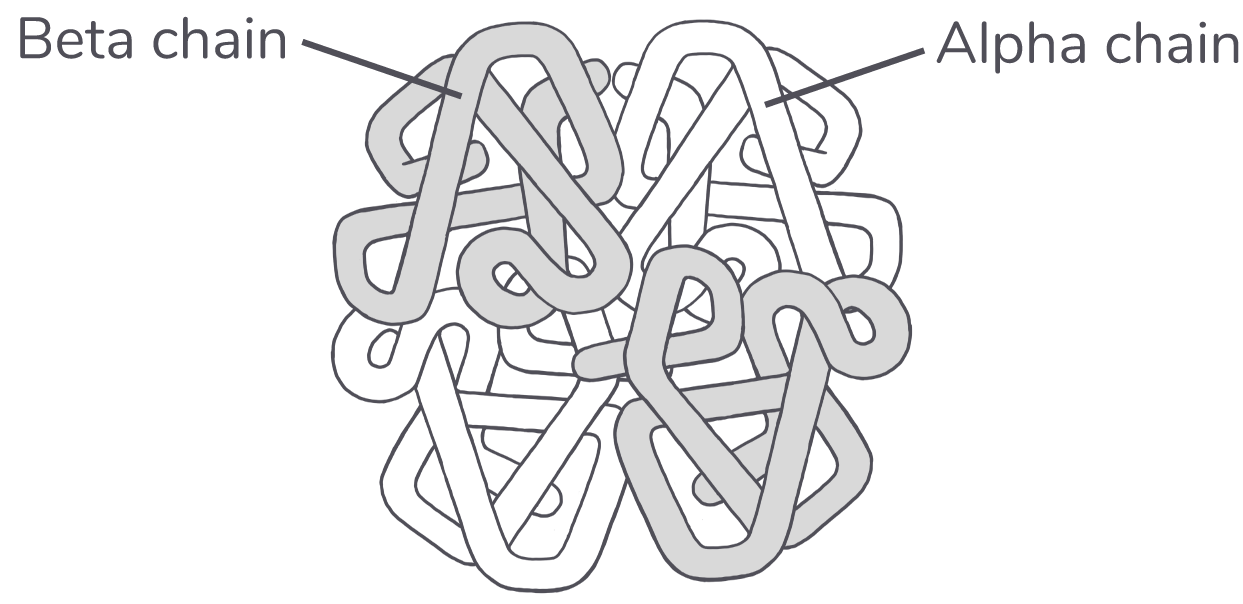
Explain why haemoglobin is described as having a quaternary structure.
Haemoglobin is composed of two alpha chains and two beta chains. The alpha chain has 141 amino acids, while the beta chain has 146 amino acids. If a sample contains 1.5 x 10⁶ molecules of haemoglobin, how many amino acids are present in the entire sample? Give your answer in standard form.
Mutations can cause a change to just one amino acid within a molecule of haemoglobin. Explain how a change to one of the amino acids could result in a change to the structure and function of a haemoglobin molecule.