Gas Exchange in Plants - exam practice
Gas Exchange in Plants
Question 1 of 6
Marram grass is a plant species that grows in sand dunes where there is very little freshwater.
The diagram below shows a cross section of a leaf from a species of marram grass.
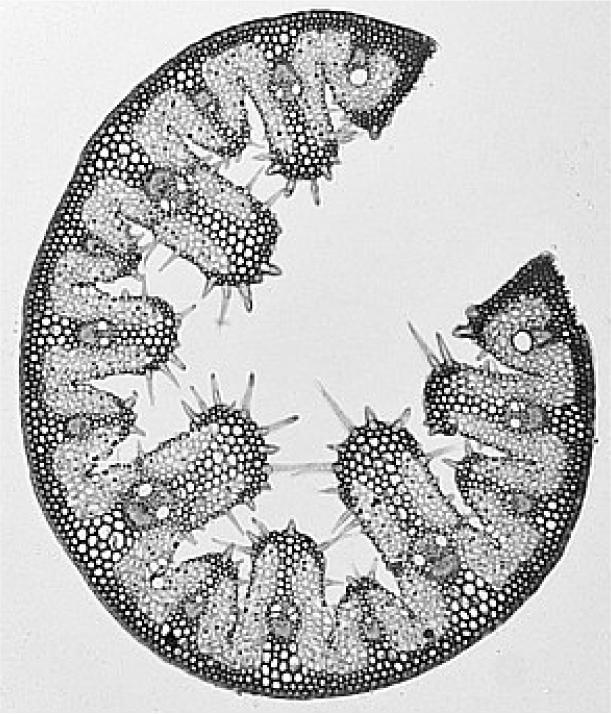
Marram grass leaves are curved inwards.
Explain how this enables the plant to survive in dry sand.
Each leaf also has a thick waxy cuticle on its surface.
Explain how this feature allows marram grass to survive in dry conditions.
Other than the two features already mentioned, give two other features of marram grass leaves that help to prevent water loss. Use the diagram above to help you.
Cells within the roots of marram grass have a very low water potential.
Suggest and explain why.
A student investigated two different species of plant, A and B.
They collected leaves from six different plants of each species and measured the surface area of each leaf as well as the number of stomata per mm2.
Their results are shown in the table below.
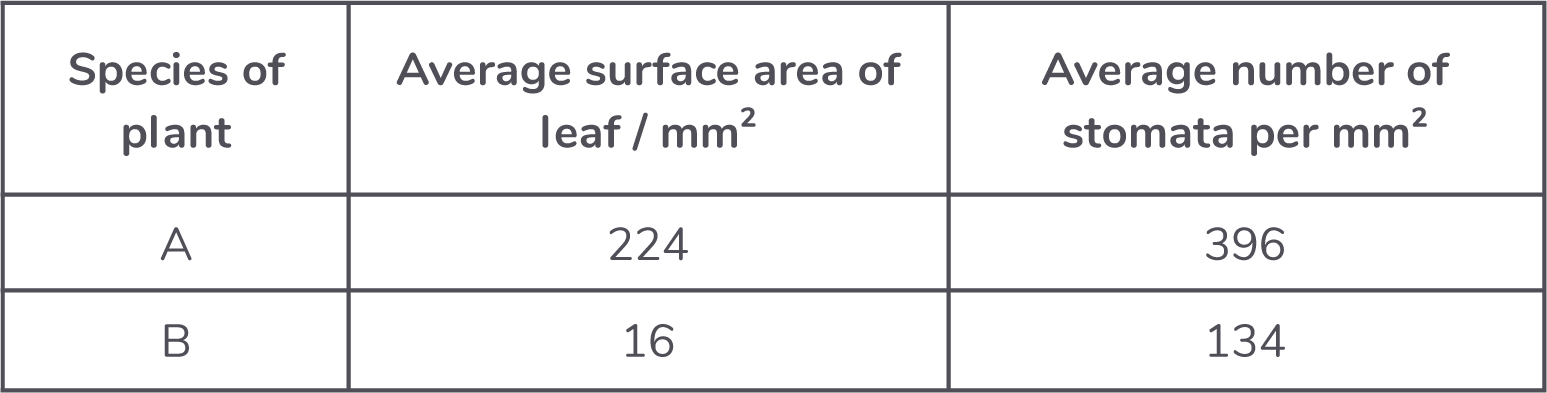
The student counted the number of stomata in several parts of each leaf.
Give two reasons why the student did this.
Using the data above, which plant species would you expect to find in a drier environment?
Explain why you chose this species.
Other than leaf surface area and number of stomata, give two features of xerophytic leaves.
For each feature described, explain how it reduces the loss of water.
Describe how carbon dioxide in the atmosphere outside a leaf reaches palisade cells inside the leaf.
The diagram below shows part of a leaf from a xerophytic plant.
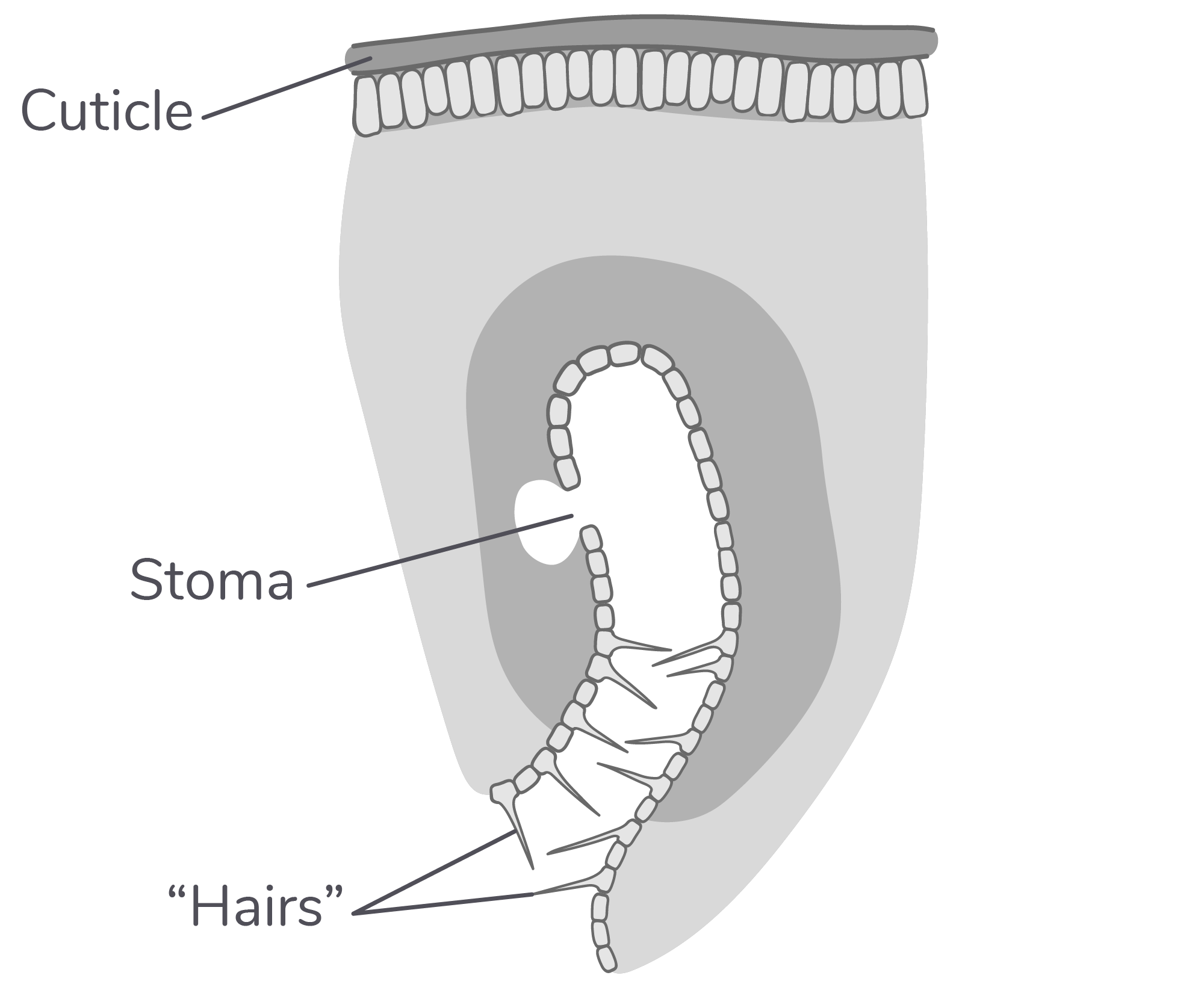
Explain how the hairs reduce water loss.
Explain how the cuticle reduces water loss.
Explain how the location of the stomata reduce water loss.
This xerophytic plant also has very few stomata per mm2 of leaf surface area.
Explain how this adaptation allows the plant to grow.
A scientist investigated how two different substances Lam13 and ABA affected the stomata diameter of a plant species.
He applied each treatment to two leaves from the same plant and then calculated the mean stomata diameter for each leaf.
He also calculated the mean stomata diameter for an untreated leaf from the same plant.
His results are shown in the table below.
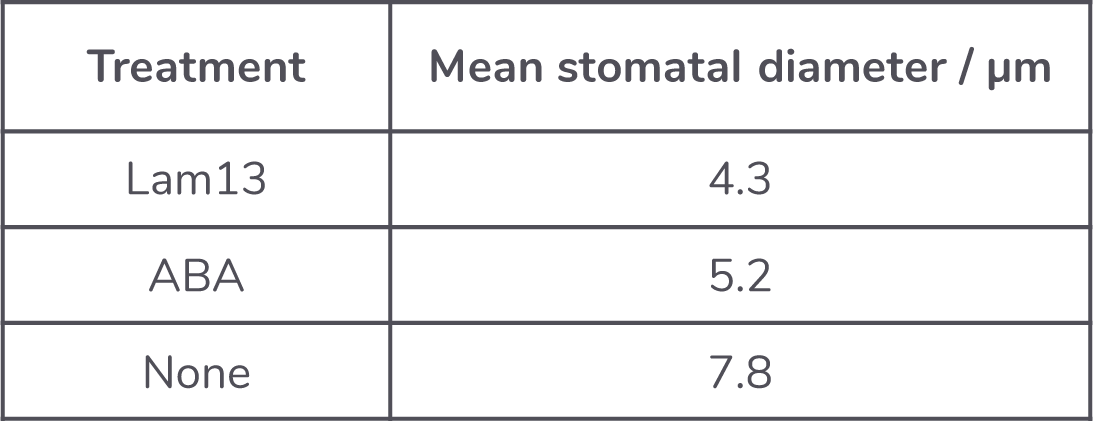
Calculate how many times greater the percentage decrease of stomata diameter is when leaves are treated with Lam13 compared to when leaves are treated with ABA.
Give your answer to 2 decimal places.
ABA is often produced by plant species when they do not have reliable access to water.
Suggest why the production of ABA can help plants to survive when water is scarce.
Other than stomata, give two other features a plant may have that enables it to grow when water is scarce.
Treatment with Lam13 can also help to protect plants against infection by pathogens.
Suggest how.
A scientist investigated the rate of carbon dioxide uptake by leaves from a plant.
The scientist measured the rate of carbon dioxide uptake by two leaves, one with an air-sealing grease applied to the lower surface and one without.
He measured the uptake for 90 minutes before turning out the lights where he continued to measure carbon dioxide uptake in the dark.
His results are shown in the diagram below.
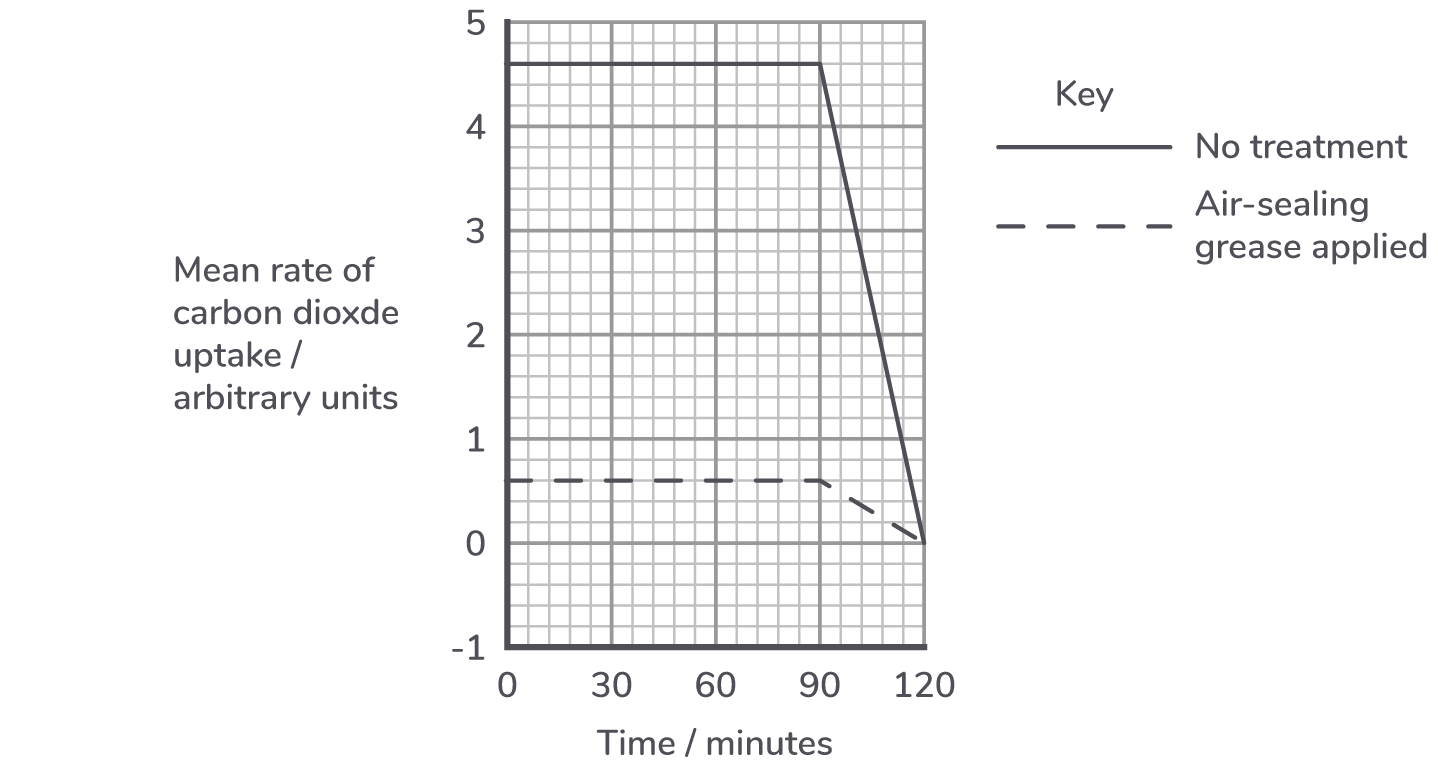
Suggest the purpose of applying no grease to one of the leaves.
Suggest the purpose of applying grease to the lower surface of one leaf.
Explain why the mean rate of carbon dioxide uptake fell after the light was turned off.
The leaf that has been treated with air-sealing grease still shows some uptake of carbon dioxide.
Suggest how this uptake of carbon dioxide is able to take place.
Scientists investigated how the water potential of leaf cells affected the growth of the leaves.
They grew chrysanthemum plants in different volumes of water, determined the water potential in the leaf cells and measured the area of the leaves.
Their results are shown below.
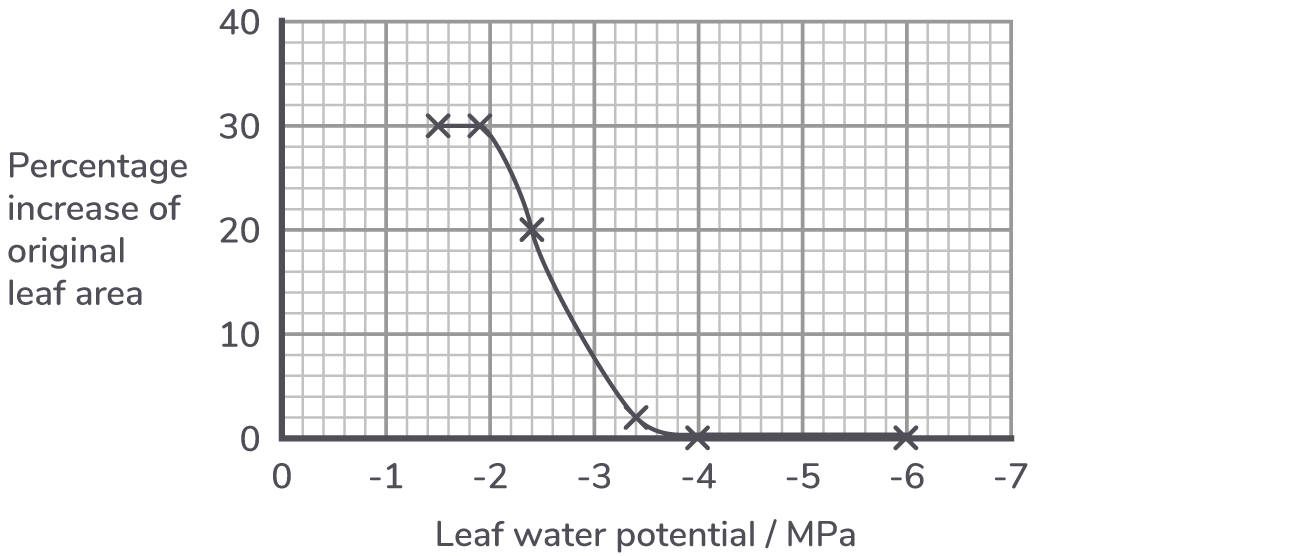
A leaf had a water potential of -2.4 MPa and had an original area of 45 cm2.
Use the diagram above to calculate how much this leaf increased in area.
The scientists wanted to carry out the same investigation with xerophytic plants rather than chrysanthemums.
Give one way the leaf growth of a xerophytic plant would be different from the leaf growth of chrysanthemums and explain why.
Explain why plants grown in soil with less water grow slowly.