Proteins - exam practice
Proteins
Question 1 of 10
1 of 10
Which level of organisation of a haemoglobin molecule is coded by a DNA molecule?
Question 2 of 10
2 of 10
The diagrams show the structures of two amino acids, each of which has two amine (–NH2) groups.
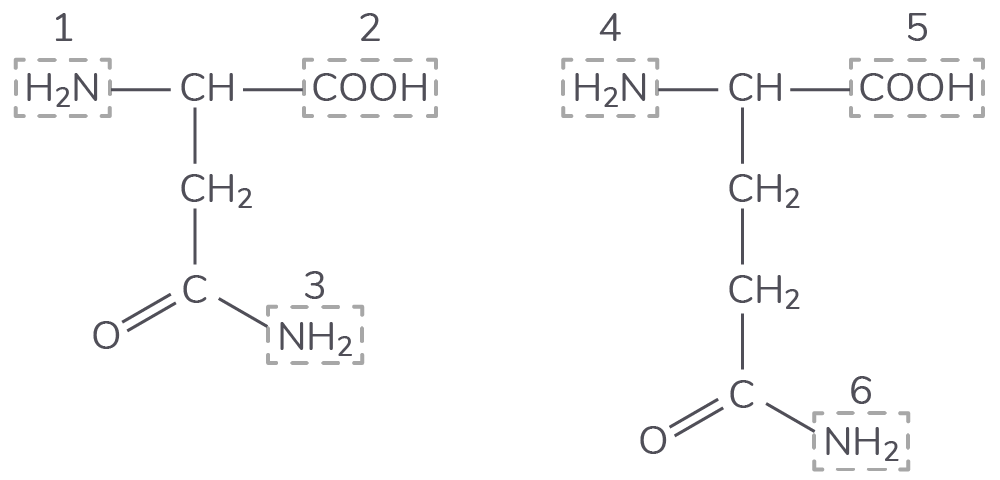
A peptide bond is formed between the two amino acids.
Which groups form the peptide bond?
Question 3 of 10
3 of 10
Which statements about a peptide bond are correct?
1 - it joins two monomers that are always identical to each other
2 - it contains four different atoms
3 - it can be broken by the addition of water at room temperature
4 - it is important in the primary structure of proteins
Question 4 of 10
4 of 10
Which statements about the primary structure of a protein are correct?
1 - it may be branched
2 - it is determined by the sequence of DNA bases
3 - it is unique to that protein
4 - it determines the tertiary structure of the protein
Question 5 of 10
5 of 10
What could describe the tertiary structure of a protein?
1 - α-helix
2 - a globular structure
3 - the specific order of amino acids
4 - a specific three-dimensional (3D) shape
Question 6 of 10
6 of 10
A conjugated protein is held together by many different types of bond.
Which bond is not formed when a conjugated protein folds into its quaternary structure?
Question 7 of 10
7 of 10
Which is the strongest type of bonding found in proteins?
Question 8 of 10
8 of 10
Lysozyme is an enzyme found in tears and saliva.
Which statement refers only to the tertiary structure of lysozyme?
Question 9 of 10
9 of 10
The diagram below is a chromatogram of three different amino acids. The distance travelled by the solvent from the baseline is 50 mm.
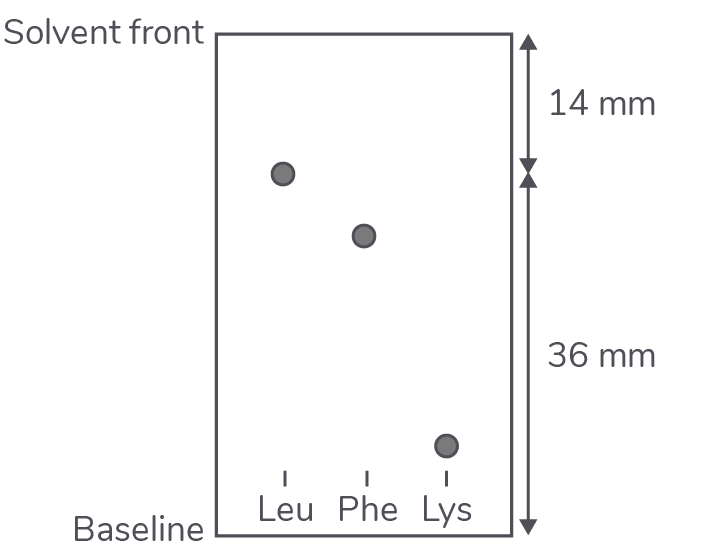
Using the information in the chromatogram, which option is the Rf value for the amino acid leucine (Leu)?
Question 10 of 10
10 of 10
Which test would you use to confirm the presence of proteins in a solution?