Gene Mutations & Protein Synthesis - exam practice
Gene Mutations & Protein Synthesis
Question 1 of 10
1 of 10
Which statements about mRNA are correct?
1 - mRNA can form base pairs
2 - mRNA can form hydrogen bonds
3 - mRNA is single stranded
Question 2 of 10
2 of 10
Which statements about tRNA are correct?
1 - hydrogen bonds between bases temporarily hold tRNA against mRNA
2 - the base sequences in the tRNA molecules are the same as the base sequences in the mRNA that is being translated
3 - tRNA translates the base sequence in mRNA into the amino acid sequence in a protein
Question 3 of 10
3 of 10
The following statements describe the process of translation:
1 - a peptide bond forms between adjacent amino acids
2 - hydrogen bonds form between the anticodon and the codon
3 - mRNA binds to the ribosome
4 - tRNA enters the ribosome carrying a specific amino acid
In which order does this process take place?
Question 4 of 10
4 of 10
The following events occur during transcription:
1 - bonds break between complementary bases
2 - bonds form between complementary bases
3 - sugar-phosphate bonds form
4 - free nucleotides pair with complementary nucleotides
Before the mRNA leaves the nucleus, which events will have occurred twice?
Question 5 of 10
5 of 10
What does the process of translation require?
Question 6 of 10
6 of 10
Which type of molecule is always the end product of transcription?
Question 7 of 10
7 of 10
The table gives tRNA anticodons for four amino acids.
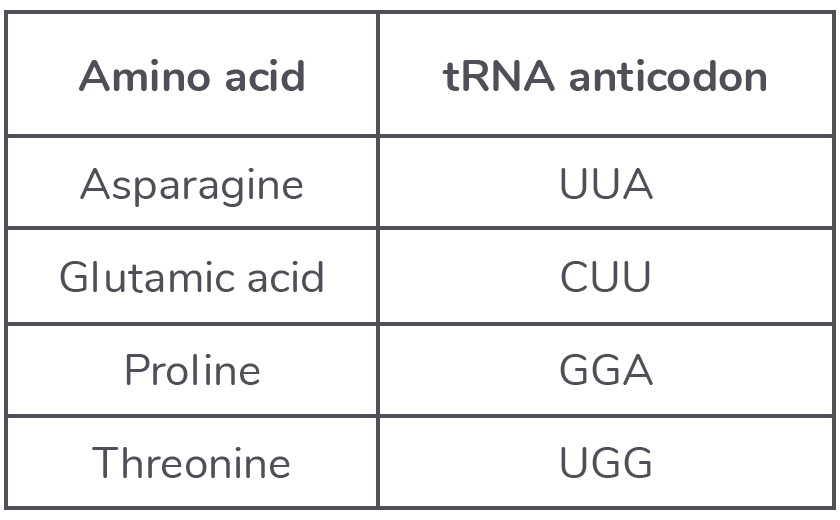
A cell makes a polypeptide with the amino acid sequence: glutamic acid – asparagine – threonine – proline
What was the sequence of bases on the strand of the DNA that was complementary to the mRNA from which this polypeptide was formed?
Question 8 of 10
8 of 10
The nucleotide sequence of a small section of a transcribed gene is as follows:
CGC CGC ACG CGC
The table shows the amino acids coded for by 10 mRNA codons.
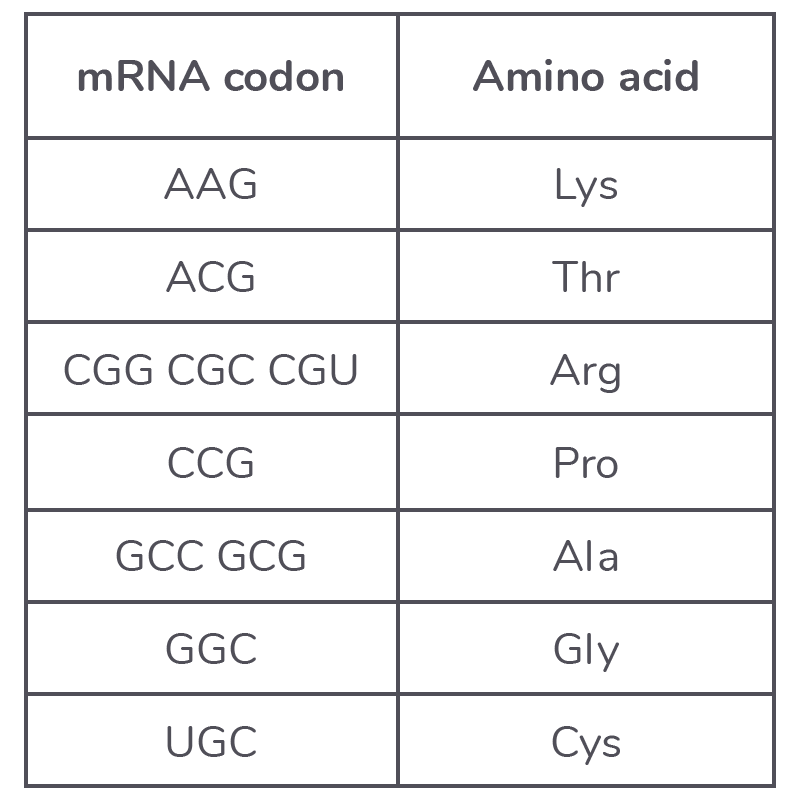
What is the order of the four amino acids in the polypeptide translated from this small section of a gene?
Question 9 of 10
9 of 10
When a gene mutation occurs, which of the following may be altered, resulting in the production of a non-functional protein?
1 - amino acid sequence
2 - DNA nucleotide sequence
3 - mRNA nucleotide sequence
Question 10 of 10
10 of 10
Rifampicin is an antibiotic used to treat tuberculosis.
It works by inhibiting RNA polymerase in bacteria.
Which of these processes will be directly inhibited by this antibiotic?