Mass Transport in Animals: Haemoglobin - exam practice
Mass Transport in Animals: Haemoglobin
Question 1 of 10
1 of 10
The graph shows the oxygen dissociation curves for haemoglobin of animals that live at high altitude and animals that live at low altitude.
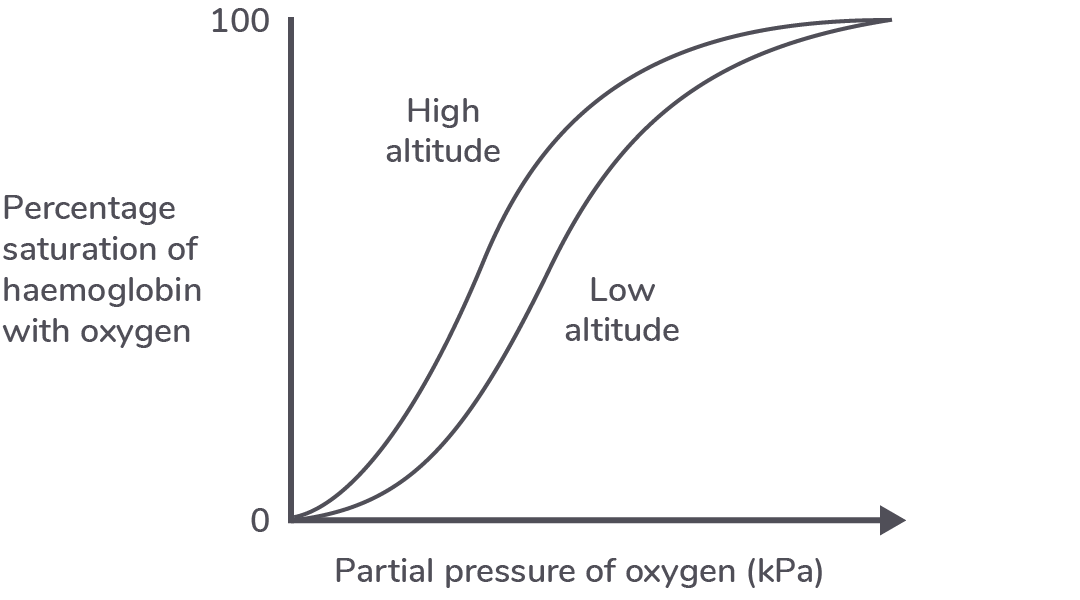
What explains the oxygen dissociation curve at high altitude?
Question 2 of 10
2 of 10
Haemoglobin can bind to carbon dioxide, carbon monoxide, and oxygen.
Which statement about the binding sites of haemoglobin is correct?
Question 3 of 10
3 of 10
An increase in carbon dioxide in human blood shifts the oxyhaemoglobin dissociation curve to the right.
What is the explanation for this effect?
Question 4 of 10
4 of 10
Which statement describes the Bohr effect?
Question 5 of 10
5 of 10
What is the reason for an increase in red blood cells in humans at high altitudes?
Question 6 of 10
6 of 10
What is the primary structure of haemoglobin made up of?
Question 7 of 10
7 of 10
Which statement best describes cooperative binding in haemoglobin?
Question 8 of 10
8 of 10
Why does haemoglobin offload more oxygen into tissues with high metabolism?
Question 9 of 10
9 of 10
What effect does a low pH have on the affinity of haemoglobin for oxygen?
Question 10 of 10
10 of 10
Haemoglobins with a high affinity for oxygen are characterised by their ability to do what?