Synaptic Transmission - exam practice
Synaptic Transmission
Question 1 of 12
1 of 12
Animals receive different stimuli from their environment. Their synapses can manage multiple stimuli, often resulting in one response (such as a muscle twitching).
What is this action of the synapse an example of?
Question 2 of 12
2 of 12
The diagram below refers to a synapse.
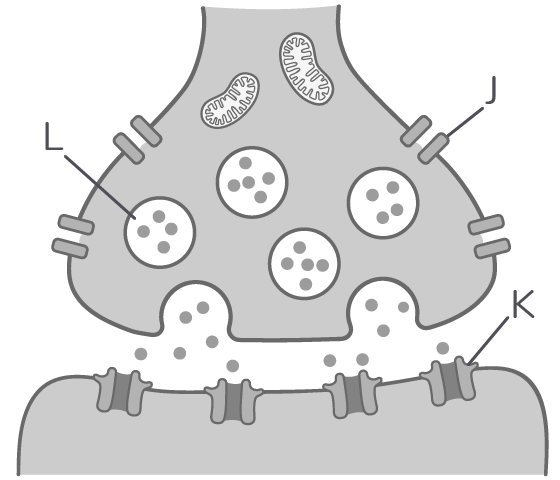
Which statement describes events occurring at a synapse?
Question 3 of 12
3 of 12
The diagram below refers to a synapse.
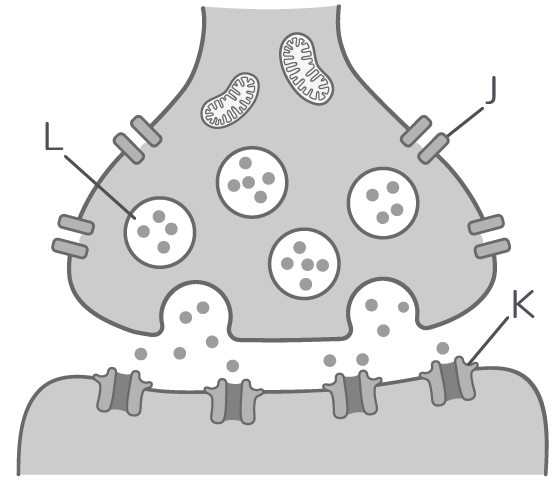
GABA is a neurotransmitter. GABA reduces the number of action potentials in the postsynaptic neurone by opening chloride ion channels in the postsynaptic membrane.
Which statement describes the action of GABA?
Question 4 of 12
4 of 12
Excitatory and inhibitory postsynaptic potentials have similarities and differences.
What is a feature of an excitatory, but not inhibitory, postsynaptic potential?
Question 5 of 12
5 of 12
Neurotransmitters such as GABA are found at synapses within the human brain and are known as inhibitory neurotransmitters.
GABA binds to receptors in the postsynaptic membrane and causes potassium ion channels to open.
Why does this prevent an action potential in the postsynaptic neurone?
Question 6 of 12
6 of 12
What is temporal summation?
Question 7 of 12
7 of 12
What occurs as a result of hyperpolarisation at an inhibitory synapse?
Question 8 of 12
8 of 12
What happens when neurotransmitter molecules bind to receptor sites on the postsynaptic neuron?
Question 9 of 12
9 of 12
What is the primary purpose of synaptic vesicles?
Question 10 of 12
10 of 12
During synaptic transmission, the opening of which ion channels directly triggers the release of neurotransmitter?
Question 11 of 12
11 of 12
What effect does the enzyme acetylcholinesterase have in the synapse?
Question 12 of 12
12 of 12
What is the consequence of the influx of sodium ions into the postsynaptic neuron?