Populations & Evolution - exam practice
Populations & Evolution
Question 1 of 12
1 of 12
Selection pressure can affect homozygous individuals. The effect can be investigated using a model gene pool.
Why is a large gene pool necessary?
Question 2 of 12
2 of 12
A number of events occur for a new species to emerge in a population.
Which statement(s) correspond(s) to events that are involved in the formation of a new species?
1 - gene mutation
2 - selection pressure
3 - a change in the environment
Question 3 of 12
3 of 12
The adult wandering albatross, Diomedea exulans, has wingspans that range from 2.5 m to 3.5 m.
What describes the variation in wingspan of the wandering albatross?
Question 4 of 12
4 of 12
The ability to roll one’s tongue is under the control of a single gene. The gene has two alleles R and r.
People who can roll their tongues can have the genotypes RR or Rr. People who cannot roll their tongues have the genotype rr.
A survey by a student showed that 12% of the population in a single school cannot roll their tongues.
The student then used the Hardy-Weinberg principle to calculate the number of heterozygous individuals in the school.
What is the percentage of heterozygous individuals at the student’s school?
Use the equations: p + q = 1 and p2 +2pq + q2 = 1
Question 5 of 12
5 of 12
The two histograms represent the frequency distribution for the two different types of variation.
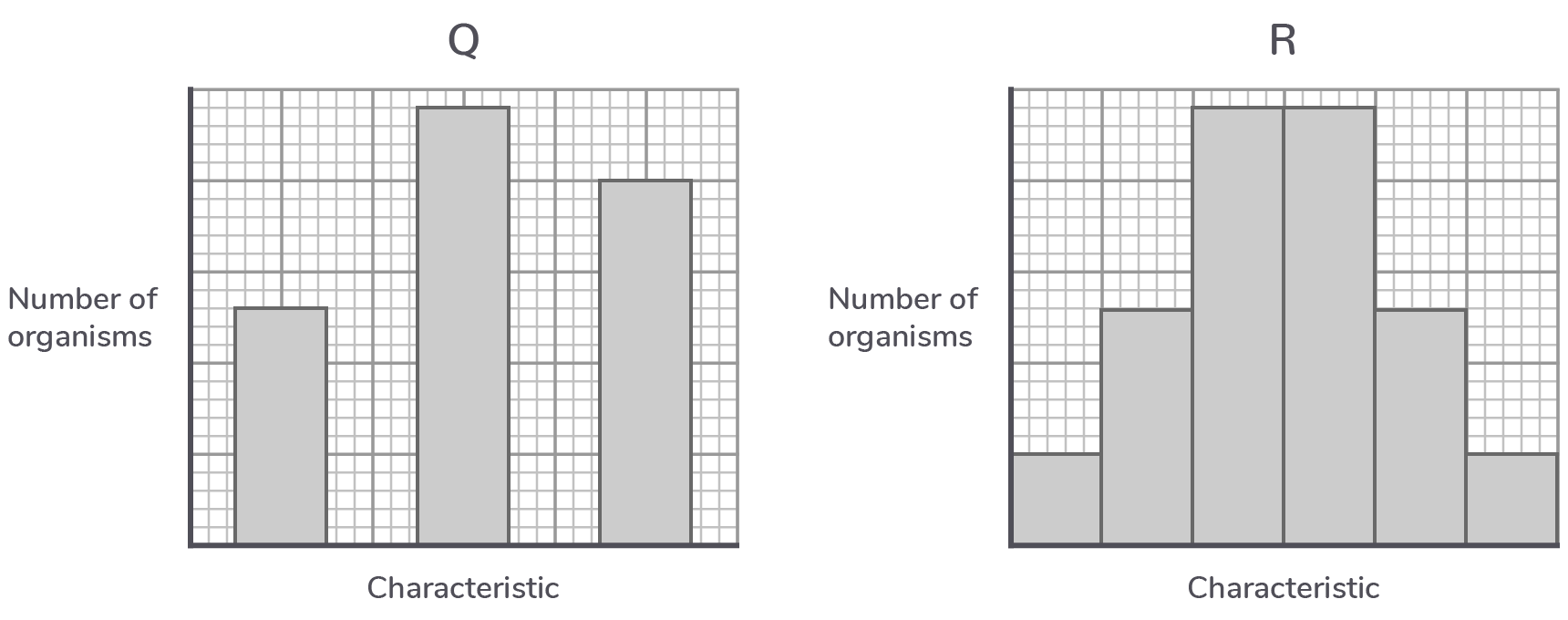
Which statement about characteristic Q is correct?
Question 6 of 12
6 of 12
There are four different human blood groups: A, B, AB, and O.
This is because there are three different alleles coding for different proteins in red blood cells.
What describes this form of variation?
Question 7 of 12
7 of 12
Which process directly results in sympatric speciation?
Question 8 of 12
8 of 12
Which process results in allopatric speciation?
Question 9 of 12
9 of 12
What describes the situation when two distinct forms of a species survive and reproduce more successfully than intermediates?
Question 10 of 12
10 of 12
What does disruptive selection typically result in?
Question 11 of 12
11 of 12
What type of selection favours phenotypes that vary in one direction from the mean of the population?
Question 12 of 12
12 of 12
What is/are the primary source(s) of genetic variation in sexually reproducing organisms?