ATP, Water & Inorganic Ions - exam practice
ATP, Water & Inorganic Ions
Question 1 of 10
1 of 10
The figure below shows the structure of an ATP molecule.
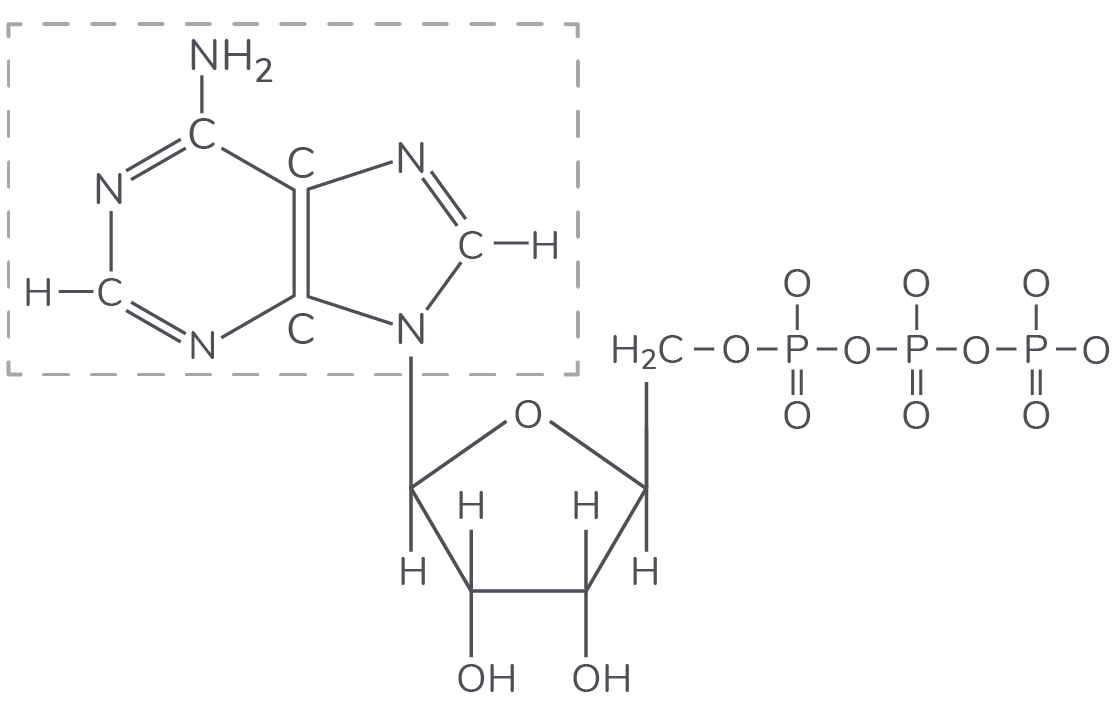
Which part of the ATP molecule is shown within the dashed rectangle?
Question 2 of 10
2 of 10
Which property of water makes it most suitable for transport in eukaryotic organisms?
Question 3 of 10
3 of 10
As a frozen lake warms after a cold winter, mineral nutrients are brought to the surface.
Which properties of water contribute to this process?
1 - its greatest density is at 4°C
2 - it has a high specific heat capacity
3 - it is a solvent
4 - its molecules form hydrogen bonds
Question 4 of 10
4 of 10
Why may fish living in ponds survive temperatures below 0°C in winter?
Question 5 of 10
5 of 10
The statements describe some of the properties of water.
1 - requires a lot of heat energy to evaporate
2 - retains a lot of heat energy
3 - is able to form hydrogen bonds with other water molecules
4 - is able to form hydrogen bonds with other polar and non-polar molecules
Which properties are important for transport in xylem?
Question 6 of 10
6 of 10
Polar molecules form hydrogen bonds with each other.
Which properties of water result from its molecules being polar?
1 - good solvent
2 - high specific heat capacity
3 - high surface tension
4 - cohesive
Question 7 of 10
7 of 10
Which properties of water are important for transport in xylem?
1 - cohesion
2 - adhesion
3 - high energy requirement for evaporation
4 - good solvent properties
Question 8 of 10
8 of 10
Which statement correctly describes the process of adhesion?
Question 9 of 10
9 of 10
A student wrote the following statement:
‘Water is polar because the oxygen side of the molecule is slightly positive in charge.’
Which option explains why this statement is not correct?
Question 10 of 10
10 of 10
Water flows continuously through xylem vessels due to cohesion.
Which option is responsible for the cohesive properties of water?