Nucleic Acids & DNA Replication - exam practice
Nucleic Acids & DNA Replication
Question 1 of 13
1 of 13
Which statement describes the semi-conservative replication of DNA?
Question 2 of 13
2 of 13
A length of double-stranded DNA contains 120 nucleotides and codes for polypeptide X.
What is the maximum length of polypeptide X?
Question 3 of 13
3 of 13
During semi-conservative replication of DNA in eukaryotic cells, the following processes occur:
1 - free nucleotides are hydrogen bonded to those on the exposed strand
2 - hydrogen bonds are broken between the complementary base pairs
3 - the cell receives the signal to begin to divide
4 - covalent bonds form between adjacent nucleotides on the same strand
5 - the DNA double helix is unwound
Which shows the correct order of some of the processes?
Question 4 of 13
4 of 13
Which statements about complementary base pairing are correct?
1 - cytosine forms two hydrogen bonds with guanine
2 - purines and pyrimidines are different sizes
3 - adenine forms the same number of hydrogen bonds with thymine and uracil
4 - the base pairs are of equal length
Question 5 of 13
5 of 13
What would be the result of analysing part of a DNA molecule?
Question 6 of 13
6 of 13
During the semi-conservative replication of DNA, which of these enzymes is required to break hydrogen bonds between the nitrogen-containing bases?
Question 7 of 13
7 of 13
The diagram below shows the structure of a nucleotide. A bond is labelled X.
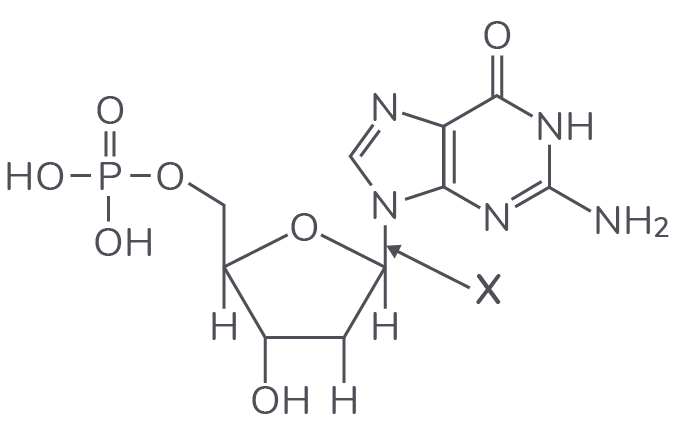
Which statement(s) is/are correct?
1 - X is a phosphodiester bond
2 - the sugar is deoxyribose
3 - the base is a purine
Question 8 of 13
8 of 13
Which statement describes the function of DNA polymerase?
Question 9 of 13
9 of 13
DNA carries the genetic code, which is non-overlapping and degenerate.
Which option contains the correct definitions for non-overlapping and degenerate code?
Question 10 of 13
10 of 13
The following statements are about the structure of DNA:
1 - purine bases pair with pyrimidine bases
2 - phosphodiester bonds link adjacent nucleotides
3 - there are always equal amounts of adenine and guanine
Which statement(s) is/are true?
Question 11 of 13
11 of 13
How many hydrogen bonds are holding the two strands of this section of a DNA molecule together?

Question 12 of 13
12 of 13
Which statement about nitrogenous bases is correct?
Question 13 of 13
13 of 13
A double stranded DNA molecule was analysed and 29% of its nucleotide bases were found to be adenine.
What percentage of its nucleotide bases will be cytosine?